The rise and fall of Gadhafi


Libyan leader's 42-year rule began with quick ascent to power
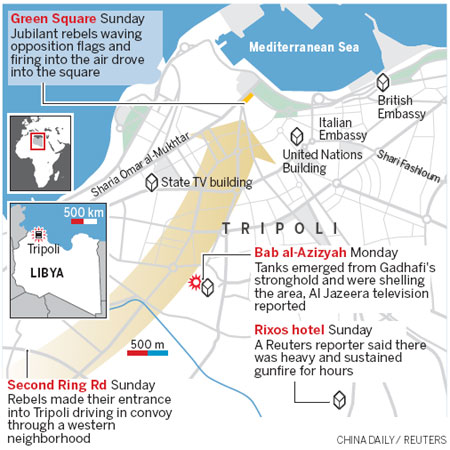
TRIPOLI, Libya - Libyan leader Muammar Gadhafi's rule is crumbling after over four decades in power, after the rebel troops took control of much of the capital Tripoli on Sunday night and his son Saif al-Islam has been detained.
Since protests erupted in Libya in earlier this year, which were inspired by similar anti-government demonstrations in other Arab countries, 69-year-old Gadhafi and the oil-rich North African nation, with a population of about 6.5 million, have stayed in international media spotlight.
Top figure
Gadhafi entered Benghazi Military University Academy before serving in the Libyan army in 1965 and was sent to Britain's Royal Military Sandhurst for training in 1966.
His rule started in September 1969, after the then junior officer, leading several of his colleagues in the "Free Officers Movement", staged a bloodless coup that toppled aging King Idris, who was then undergoing medical treatment in Turkey, and established the Libyan Arab Republic. Gadhafi became the chairman of the Revolutionary Command Council (RCC) and commander-in-chief of the Armed Forces of Libya.
He served as the country's minister of defense while being the prime minister from 1970 to 1972. In 1977, he became the "Brother Leader and Guide of the Revolution", and relinquished all administration positions in 1979, retaining only this title.
Fed up with monarchical corruption and earlier colonial occupation (Italy dominated Libya from 1911-1951), Gadhafi, starting from the 1970s, made the Libyan people beneficiaries of free education, free healthcare and subsidized housing and transport, with the help of the country's huge oil revenue and its relatively small population.
In the mean time, he imposed strict Islamic governance, banning vices like gambling and alcohol, and started a system of Islamic morals in the country. Cities like the capital Tripoli started to flourish with new buildings and hotels, turning into a destination for tourists and businessmen from across the world.
But these efforts proved inadequate to speed up and diversify the country's growth to the largest extent.
As a result, sectors including Libya's healthcare system started to decline.
Reports by Al-Arabiya television said shortly after the outbreak of the turmoil this year that some Libyan citizens were resorting to Tunisia, Egypt and Jordan for necessary medical treatment, paying billions of dollars a year, after finding the system in their own country was ineffective and unreliable.
The Saudi-based channel said public trust in the nation's healthcare system was eroded especially after contaminated medical tools led to more than 500 children in Benghazi being infected with HIV in 1999.
Defiant leader
The protests should have hardly been a challenge for Gadhafi. Born in the desert region of Sirte in 1942 and a lifelong soldier, he has survived numerous wars with countries such as Chad and Uganda in the 1980s, as well as repeated assassination plots including one in 1996 - allegedly by Britain's Secret Intelligence Service after a decade-long cessation of ties which was triggered by the killing of a British policewoman by Libyan diplomats in 1984.
Gadhafi is mostly known for his defiance following the December 1988 bombings of a plane over Lockerbie in Scotland, in which Libyans were implicated.
The hijacking claimed 270 civilian lives - 189 were US citizens - and was deemed as one of a series of acts of violence in the 1980s between the United States and non-state or state-sponsored terrorist groups in the region.
Gadhafi refused to turn over the terrorist suspects until 1999. In 2003, Libya formally claimed responsibility for the bombing, but never offered an apology for the attack. In 2009, when the only convicted Lockerbie bomber Abdel Basset al-Megrahi was released from a Scottish prison on compassionate grounds, Gadhafi welcomed him at the airport, again outraging Washington.
But Gadhafi also made compromises, especially after years of sanctions by Western countries as well as the United Nations in the 1990s. In 2001, Gadhafi quickly denounced the Sept 11, 2001 terrorist attacks in the United States. He also announced in 2003 Libya's abandonment of its weapons of mass destruction programs.
Civil war
But, having found the demonstrators in February's rallies unusually determined, Gadhafi resorted to force, launching indiscriminate attacks which claimed civilian lives. But violent clashes simply sharpened antagonism and shoved the country to the brink of a civil war.
Some government officials then defected, picking up weapons to join the protesters and the rebels. However, the rebel troops, out-of-uniform and with only a meager arsenal, were no match for government forces. But a UN resolution, adopted on March 17, won respite for them.
A resolution proposed by France, Lebanon and Britain in the name of protecting civilians demanded an immediate cease-fire, authorized the establishment of a no-fly zone over Libya and strengthened the arms embargo. It essentially provided the legal basis for military intervention in the domestic conflict.
As the Libyan government failed to observe a cease-fire as announced, France, Britain and the US started air strikes on March 19 that aimed to defeat Gadhafi. And on May 31, NATO took over the command of the military operation in Libya after its only Muslim member Turkey agreed to the plan.
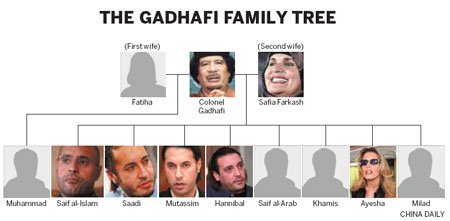
Daily targeted raids have claimed the lives of Gadhafi's son Saif al-Arab, three of his grandchildren, forced him to hide and severely degraded his military capacity. Meanwhile, he fell further into disgrace as countries including France, Qatar, and the US recognized the rebel National Transitional Council as the sole legitimate representative of the Libyan people.
Countries that were once on the side of the Libyan government such as Russia also took a turn in May called on that Gadhafi give up power. But he continued with his defiance, ignoring the arrest warrants sought by the International Criminal Court and rebuffed the mediation efforts of South African President Jacob Zuma.
But since July, Gadhafi gradually left the public eye. His forces waned from then on, as Libyan rebels said recently that they had taken the gateway of Tripoli, Zawiyah, cutting the coastal highway to Tunisia which keeps the capital supplied with food and fuel, and that they had taken control of Zliten in the west front, a remarkable move to completely cut off roads to the capital.
Xinhua