|
|||||||||||


LONDON - Astronomers have found the first comet with ocean-like water in a major boost to the theory that the celestial bodies were a significant source of water for a thirsty early Earth.
The intense heat of the planet immediately after it formed means any initial water would have quickly evaporated and scientists believe the oceans emerged around 8 million years later.
 |
|
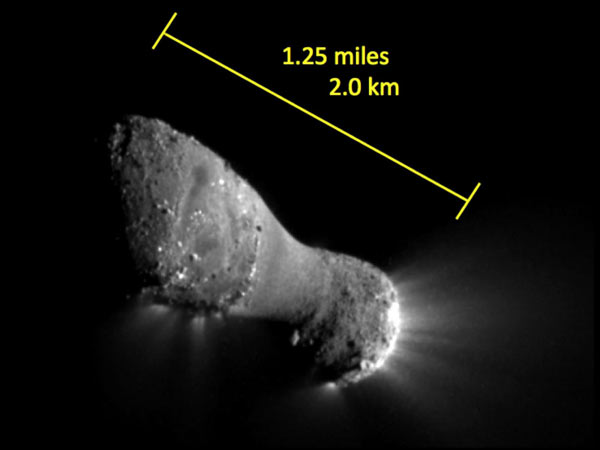
The comet Hartley is seen in this undated NASA handout image. [Photo/Agencies] |
The puzzle is where the water, which is vital for life on Earth, came from.
Past analysis of water-ice from far-flung comets suggested they could have delivered no more than 10 percent of today's oceans because the chemical "fingerprints" did not match up.
But research from Paul Hartogh of Germany's Max Planck Institute for Solar System Research and colleagues published on Wednesday showed a comet called 103P/Hartley 2 has the same chemical composition as the Earth's oceans.
The finding substantially increases the amount of water that could have originated from comets, which are made up of rock and ice with a characteristic tail of gas and dust. Previous models of the early Earth implied most water came from asteroids.
In the case of Hartley 2, researchers using infrared instruments on the Hershel Space Observatory found that ice on the comet has a near identical "D/H" ratio to seawater. D/H measures the proportion of deuterium -- or heavy hydrogen, which has an extra neutron -- compared to ordinary hydrogen in water.
"It was a big surprise when we saw the ratio was almost the same as what we find in the Earth's oceans," Hartogh told Reuters.
"It means it is not true any more that a maximum of 10 percent of water could have come from comets. Now, in principle, all the water could have come from comets."
Hartogh, whose research was published online in Nature, believes Hartley 2, whose current orbit around the sun does not extend much beyond Jupiter, started life in a different part of the solar system than other comets studied.
It probably formed in the Kuiper belt, which lies about 30 to 50 times further from the sun than the Earth, while the others come from the Oort Cloud, some 5,000 times further away.








Hot Topics
Libya conflict, Gaddafi, Oil spill, Palace Museum scandal, Inflation, Japan's new PM, Trapped miners, Mooncake tax, Weekly photos, Hurricane Irene
Editor's Picks

|

|

|

|

|

|