|
|||||||||||


CAPE CANAVERAL, Fla. - A six-tonne NASA science satellite crashed to Earth on Saturday, leaving a mystery about where a tonne of space debris may have landed.
The US space agency said it believes the debris ended up in the Pacific Ocean, but the precise time of the bus-sized satellite's re-entry and the location of its debris field have not been determined.
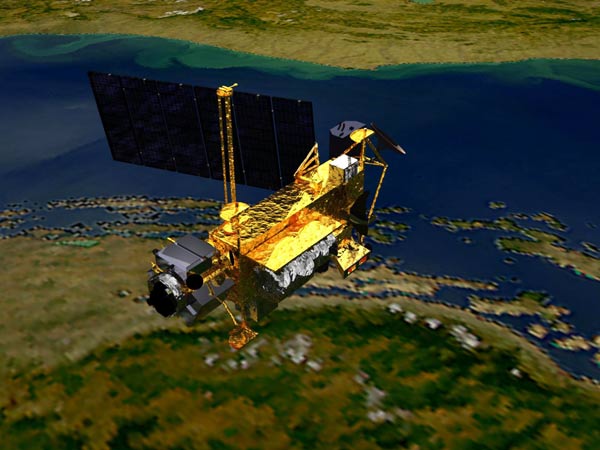 |
|
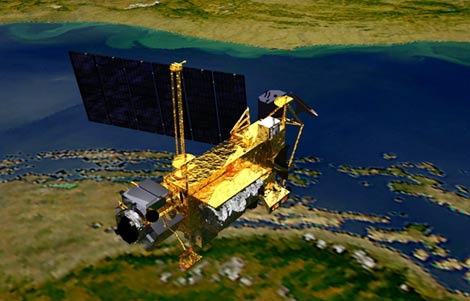
NASA conceptual image shows the Upper Atmosphere Research Satellite (UARS), launched on September 15, 1991, by the space shuttle Discovery. [Photo/Agencies] |
The Upper Atmosphere Research Satellite, or UARS, ended 20 years in orbit with a suicidal plunge into the atmosphere sometime between 11:23 pm on Friday and 1:09 am EDT on Saturday (0323 to 0509 GMT Saturday), NASA said.
The satellite would have been torn apart during the fiery re-entry, but about 26 pieces, the largest of which was estimated to have weighed 330 pounds (150 kg), likely survived the fall, officials said.
As it fell to Earth, UARS passed from the east coast of Africa over the Indian Ocean, then the Pacific Ocean, across northern Canada and the northern Atlantic Ocean to a point over West Africa. Most of the transit was over water, with some flight over northern Canada and West Africa, NASA said.
"Because we don't know where the re-entry point actually was, we don't know where the debris field might be," said Nicholas Johnson, chief orbital debris scientist at NASA's Johnson Space Center in Houston. "We may never know."
Stretching 35 feet (10.7 meters) long and 15 feet (4.6 meters) in diameter, UARS was among the largest spacecraft to plummet uncontrollably through the atmosphere, although it is a slim cousin to NASA's 75-tonne (68,000 kilogram) Skylab station, which crashed to Earth in 1979.
Russia's last space station, the 135-tonne (122,000 kilogram) Mir, crashed into the Pacific Ocean in 2001, but it was a guided descent.
NASA now plans for the controlled re-entry of large spacecraft, but it did not when UARS was designed.
The 13,000-pound (5,897 kg) satellite was dispatched into orbit by a space shuttle crew in 1991 to study ozone and other chemicals in Earth's atmosphere.
It completed its mission in 2005 and has been slowly losing altitude ever since.
With most of the planet covered in water and vast uninhabited deserts and other land directly beneath the satellite's flight path, the chance that someone would be hit by falling debris was 1-in-3,200, NASA said.
"The risk to public safety is very remote," it said.
The satellite flew over most of the planet, traveling between 57 degrees north and 57 degrees south of the equator.
UARS was one of about 20,000 pieces of space debris in orbit around Earth. Something the size of UARS falls back into the atmosphere about once a year.
Related Stories
Lifeless satellite falls back to Earth 2011-09-24 07:53
Tumbling satellite to miss North America 2011-09-23 15:27






Hot Topics
Libya conflict, Gaddafi, Oil spill, Palace Museum scandal, Inflation, Japan's new PM, Trapped miners, Mooncake tax, Weekly photos, Hurricane Irene
Editor's Picks

|
|
|

|

|

|