Global General
One scientist's hobby: recreating the ice age
(Agencies)
Updated: 2010-11-28 20:50
 |
Large Medium Small |
CHERSKY, Russia - Wild horses have returned to northern Siberia. So have musk oxen, hairy beasts that once shared this icy land with woolly mammoths and saber-toothed cats. Moose and reindeer are here, and may one day be joined by Canadian bison and deer.
|
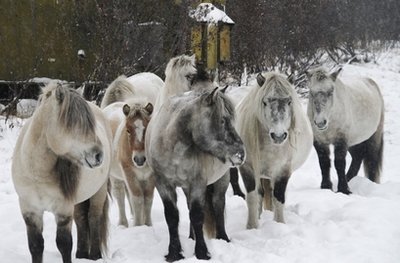 In this Oct 25, 2010 photo, semi-wild Yakutian horses are seen at the Pleistocene Park, a 40,000 acre wilderness in northern Siberia, Russia. Russian scientist Sergey Zimov is trying to recreate conditions from the end of the Ice Age when this area was rich in wildlife and summer meadows. [Photo/Agencies] |
Later, the predators will come -- Siberian tigers, wolves and maybe leopards.
Russian scientist Sergey Zimov is reintroducing these animals to the land where they once roamed in millions to demonstrate his theory that filling the vast emptiness of Siberia with grass-eating animals can slow global warming.
|
||||


Climate change is felt most sharply in the Arctic, where temperatures are warming faster than anywhere else on the planet. Most climate scientists say human activity, especially industrial pollution and the byproducts of everyday living like home heating and driving cars, is triggering an unnatural warming of the Earth. On Monday, negotiators representing 194 countries open a two-week conference in Cancun, Mexico, on reducing greenhouse gases to slow the pace of climate change.
Zimov is trying to recreate an ecosystem that disappeared 10,000 years ago with the end of the ice age, which closed the 1.8 million-year Pleistocene era and ushered in the global climate roughly as we know it.
He believes herds of grazers will turn the tundra, which today supports only spindly larch trees and shrubs, into luxurious grasslands. Tall grasses with complex root systems will stabilize the frozen soil, which is now thawing at an ever-increasing rate, he says.
Herbivores keep wild grass short and healthy, sending up fresh shoots through the summer and autumn. Their manure gives crucial nourishment. In winter, the animals trample and flatten the snow that otherwise would insulate the ground from the cold air. That helps prevent the frozen ground, or permafrost, from thawing and releasing powerful greenhouse gases. Grass also reflects more sunlight than forests, a further damper to global warming.
It would take millions of animals to change the landscape of Siberia and effectively seal the permafrost. But left alone, Zimov argues, the likes of caribou, buffalo and musk oxen multiply quickly. Wherever they graze "new pastures will appear ... beautiful grassland."