Global General
Tech alliance needed to fight global warming
By Lan Lan and Li Jing (China Daily)
Updated: 2010-10-07 10:12
 |
Large Medium Small |
TIANJIN - Top Chinese climate change official Xie Zhenhua stressed the urgent need for technology transfers in the realm of developing nations on Wednesday.
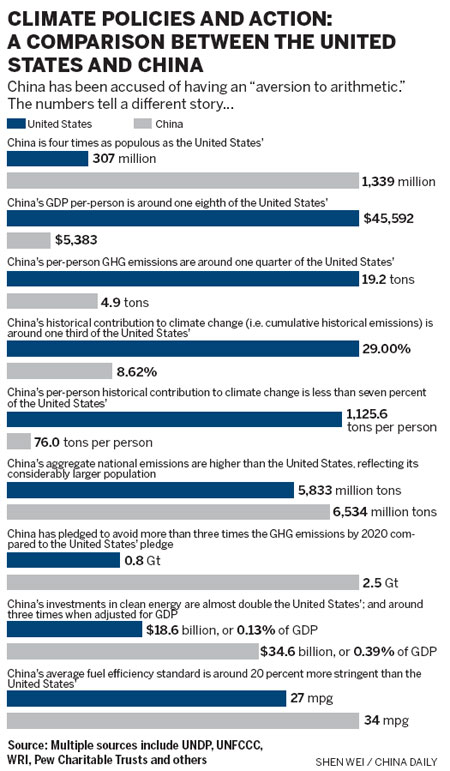
The scale and timing of finance and technology transfers within developed countries is a decisive factor for industrializing countries' efforts to mitigate climate change, Xie Zhenhua, deputy chief of the National Development and Reform Commission, told a group of journalists on the sideline of the United Nations climate change negotiations in Tianjin.
"If the developed countries are more willing to transfer finance and technology to developing countries, the world's emission peak time will come sooner," Xie said.
"Developed countries have yet to be prepared to deliver technologies, and I hope we can achieve more in this aspect in the coming summit in Cancun in November," he said.
For instance, Xie recalled once giving a list with 42 technologies needed by six Chinese industries to a minister of an industrial nation - but in the end never got a reply.
"We are striving very hard in curbing carbon emissions, if we can get more core technologies from developed countries with affordable prices, we can reach our goal faster," he said.
Limited progress has been made in terms of technology transfers during previous climate change negotiations, Su Wei, China's chief climate change official said in an interview earlier this week.
As a developing country, he noted, it's reasonable that China's carbon intensity will continue decreasing, while total amount of carbon emissions will increase - because it needs growth space for improving livelihood and reducing poverty.
However, developed countries insist that emissions cutting programs of developing countries supported with money and advanced technologies from the West should be "measurable, reportable and verifiable" - commonly known as MRV.
Moreover, the US wanted China's mitigation actions to undergo "international consultation and analysis (ICA), and even MRV where it is appropriate", said Jonathan Pershing, the US deputy special envoy for climate change, when addressing a group of NGO representatives, sources told China Daily.


Under the Copenhagen Accord signed last year, China agreed to ICA for the independent voluntary actions, although many developing countries have not.
"The ICA should not be more stringent than MRV, and should be in line with the principle of common but varied responsibilities," said Xie.
"Some countries, which I don't want to specify their names, failed to make serious efforts to cut their domestic emissions, and did little to provide financial and technological aids for developing countries.
"Instead, they requested China's voluntary domestic actions to go through the strict MRV process. That is not acceptable," he said.
China, Brazil, India, and South Africa have worked out a detailed proposal for the ICA system, which will be submitted for the negotiation, according to Xie.
Though China doesn't have an exact timetable for its peak time but the country will bring its emissions "well under control", Xie noted.
The technology transfer issue is also a precondition for rebuilding trust among countries, as industrial countries should honor their due commitment, he said.
Xie said China wants to play a "constructive" role instead of a "leading" role in the process of advancing climate change negotiations.
If the Tianjin meeting, the final meeting before the United Nations Climate Change conference in Cancun, can upgrade the chair text of the working group on the Kyoto Protocol to a member-driven draft text, and simplify the existing member-driven draft text of the working group on Long-term Cooperative Action under the UN Framework Convention on Climate Change, it will lead to the success of the meeting, Xie said.
"If the two texts could be finished, it will lay a very positive ground for the Cancun meeting," he said.
Xie said achievement of the Cancun talks would be "limited" as many divergence remains. However he urged members to act fast in areas with the least contentious such as forestry, finance and technology.
Xie said he still expects a binding climate treaty in South Africa in 2011.