 |
|
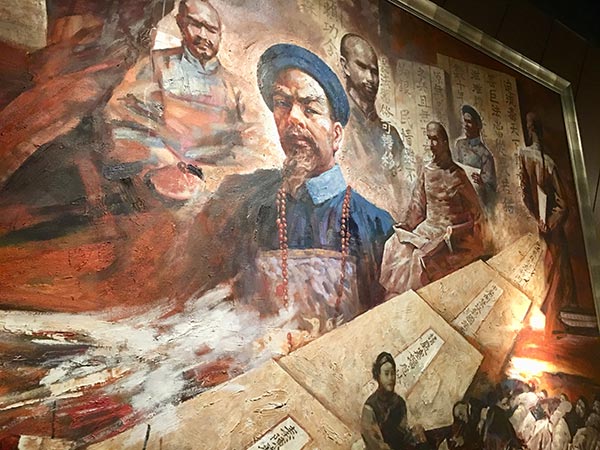
A painting of Lin Zexu, a Qing official who led an anti-opium drive in 1839. [Photo by Liang Fengxin/For China Daily] |
The imperial decree to allow foreign merchants to only trade through Canton Customs was due to the eastward expansion of the Western countries, according to exhibits at the Opium War Museum in Humen.
"It (1840) was the starting point for the great change," Wu says. "The wars made people realize then that China wasn't as strong as thought earlier and that it needed to be stronger to fight external threat."
"But China also realized that it needed to learn about the world outside," he adds.
The opium wars had turned the country into a semi-feudal, semi-colonial society, Mao Zedong, the founding father of New China, had once said.
After the end of the Qing rule and during the early days of the Republic of China, when the nationalists were in power, Sino-British relations were still uneven but that began to alter in the 1930s with the rise of the United States, and the relationship was different by the time of World War II because the US and China were both seen as anti-imperialist powers.
In addition to the opium wars, references to events of the 1930s and'40s by Chinese leaders today are also linked to a "more internationalist China that's looking outward", Mitter says.
China's post-1840 history up to 1949, when New China was founded, is known as jindaishi.
|
|
|
|
|
|
|
|

Copyright 1995 - . All rights reserved. The content (including but not limited to text, photo, multimedia information, etc) published in this site belongs to China Daily Information Co (CDIC). Without written authorization from CDIC, such content shall not be republished or used in any form. Note: Browsers with 1024*768 or higher resolution are suggested for this site.
License for publishing multimedia online 0108263 Registration Number: 20100000002731 




















 Raymond Zhou:
 Pauline D Loh:
 Hot Pot
 Eco China
 China Dream
 China Face