Behind the veil of the Forbidden City's imperial harem
|
Inside Cining Palace. Liu Chang / For China Daily |
However, Shunzhi disliked both, one of them so much that he relegated her to being a concubine. He married a Manchu noblewoman, but she died before she was designated empress. A year later the emperor himself died - at the age of 23.
Perhaps Xiaozhuang's poor relationship with her son was one of the greatest regrets of her life. Still, that did not prevent her becoming the most influential woman in the empire. When her grandson, the Kangxi Emperor (1654-1722) reigned, she was on hand to give him advice and nurtured him to become one of the most acclaimed monarchs in Chinese history.
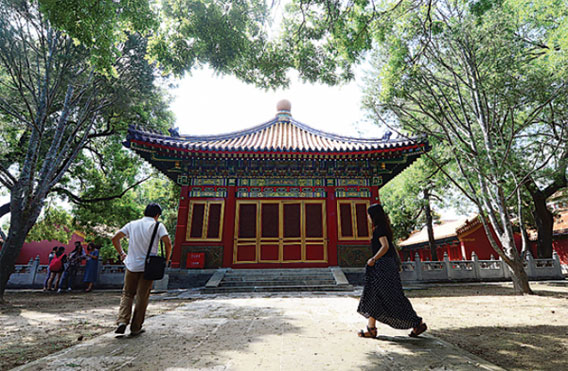
In her era and the decades after, the Cining Palace was at its zenith, and grand birthday parties were held for empress dowagers. Some princesses were also married there.
"We are now intent on bringing the Cining Palace back to life," Shan says as he talks of it becoming the museum's first permanent exhibition hall specifically for ancient sculptures when it reopens.
For visitors, about 400 cream sculptures, statues and pottery figurines dating back to the Warring States Period (475-221 BC) housed in the museum will be a cultural feast.
Shan says that in addition to the main palace, the splendor of a 6,800-square-meter garden will greet visitors. The garden may well be the only place in the Forbidden City that reflects the empresses' and concubines' glorious days.
There are also plans to throw open the gates of the Great Buddhist Temple at the rear of the palace by the end of this year. There used to be about 70 Buddhist temples in the Forbidden City but none is open to the public.
Shan says the circumstances in which Buddhist articles were taken out of the Forbidden City 42 years ago, never to return. Prince Norodom Sihanouk of Cambodia, who was in exile in China, planned to visit White Horse Temple in Luoyang, Henan province, one of the earliest Buddhist temples in China, in 1973.
However, statues in its main hall had been destroyed during the "cultural revolution" (1966-76), so White Horse Temple officials asked the central government for permission to borrow those from Cining Palace.
"In the end, for some reason Sihanouk did not visit White Horse Temple, but the borrowed items never came back," Shan says.
"Nevertheless, the Great Buddhist Temple will be used to display our current highlighted collection of Tibetan Buddhism."