Behind the veil of the Forbidden City's imperial harem
|
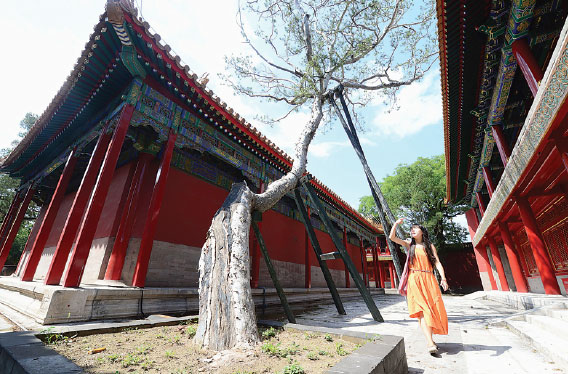
Located to the west of the Gate of Great Ancestors in the inner court of the Forbidden City, Cining Palace is the essence of ancient palace architecture. Liu Chang / For China Daily |
A part of the Forbidden City that was reduced to being a mere warehouse is about to open to the public
On a visit to the Palace Museum, also known as the Forbidden City, in Beijing recently I entered through the western gate and unexpectedly walked into a building site.
Building materials were scattered over the yard. Everyone was preparing for the opening of the museum's western area, but the gates leading to the most secret parts were still locked to outsiders.
The country's most powerful women once lived in that part of the Forbidden City, China's imperial palace, between 1420 to 1911.
However, since China's monarchy fell more than 100 years go, rollicking legends of empress dowagers and empresses have disappeared beneath overgrown wild grass.
When Shan Jixiang, director of the Palace Museum, announced this year that Cining Palace (the Palace of Compassion and Tranquility), the core of the western wing, was to open for visitors for the first time in July to celebrate the museum's 90th anniversary, it well and truly whetted appetites for tales of what went on inside the imperial harem.
So those who were hanging on for such things may be disappointed to know that few vestiges of the empresses' lives are left, Shan says. In fact, the once glorious Cining Palace was at one stage reduced to being nothing more than a warehouse for cultural relics.
With works behind schedule, the opening date was eventually pushed back from July to October.
Replicas of the boudoirs have often seen in TV operas related to the Qing Dynasty (1644-1911), but the real ones have remained stubbornly behind veils.
Cining Palace, built in 1536 during the Ming Dynasty (1368-1644) as a residence for the late emperors' concubines, is the most important architecture in the western wing of the Forbidden City. Many tour guides call it "the widows' yard". The widows were generally very young, it being common for an empress of that era to be widowed in her 20s or 30s.
After a major renovation in 1653, Empress Dowager Xiaozhuang (1613-88), concubine of the ruler Hong Taiji, became the head of the palace and remained so until her death 35 years later. In order to keep political connections with Manchu rulers of the Qing Dynasty, this empress dowager from the Mongol tribe of Horqin arranged two marriages for her son the Shunzhi Emperor (1638-61), the first Qing monarch to live in the Forbidden City.