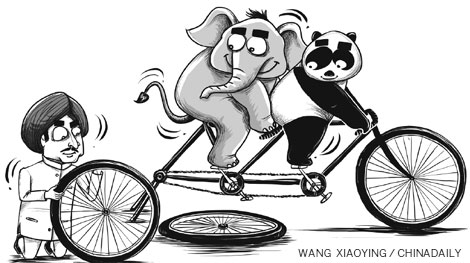
Polling began in India's general election on April 7, and a new government is expected to assume office by the end of May. The excitement in the country over the outcome of the keenly contested election is palpable. The questions being asked both within and outside the country are what will be India's foreign policy orientation after the election - and what will be its economic policy, which will have a bearing on the foreign policy. Some people are also asking whether there will be any change in India's policy toward China.
While it is difficult to predict the outcome of the election because of the changing electoral dynamics till the last minute that can swing the mood of the electorate, one need not be a rocket scientist to assert that there cannot be any radical shift in India's foreign policy orientation, including its policy toward China.
Sino-Indian relations have gone through ups and downs over the years. They have acquired a degree of dynamism and reliance which is irreversible. This has been carefully built and nurtured by succeeding leaderships of different political persuasions and predilections. Top leaders of both the Congress Party, that heads the ruling coalition (United Progressive Alliance) and the Bharatiya Janata Party, that headed the National Democratic Alliance government from 1998 to 2004, have helped strengthen relations between India and China.
Therefore, it will not be out of context to mention that when the first non-Congress government was formed in India (under the erstwhile Janata Party government in 1977), its foreign minister Atal Bihari Vajpayee (who became prime minister in 1998) visited China to improve relations between the two countries. Former prime minister Rajiv Gandhi visited China in 1988, when the two countries signed the Joint Working Group Mechanism. After Rajiv Gandhi's assassination in 1991, Narasimha Rao became India's prime minister and visited China in 1993 and signed the Agreement on Maintenance of Peace and Tranquility.
Incumbent Prime Minister Manmohan Singh and his cabinet colleagues, including Defense Minister A.K. Antony and External Affairs Minister Salman Khurshid, have invested heavily in the comprehensive engagement between the two countries and their peoples. The point is that irrespective of the leadership change in both countries, their bilateral relations have improved for the better.


Copyright 1995 - . All rights reserved. The content (including but not limited to text, photo, multimedia information, etc) published in this site belongs to China Daily Information Co (CDIC). Without written authorization from CDIC, such content shall not be republished or used in any form. Note: Browsers with 1024*768 or higher resolution are suggested for this site.
License for publishing multimedia online 0108263 Registration Number: 130349