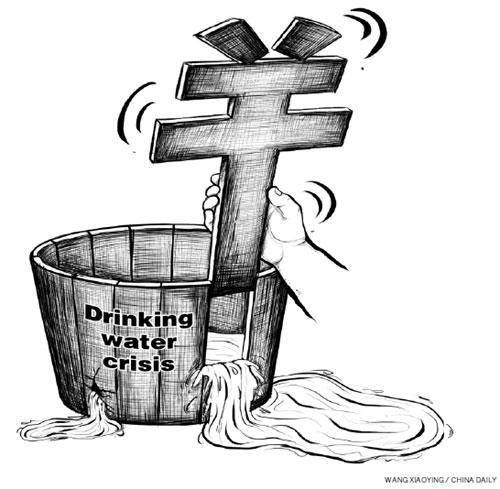
China's economic growth during the past three decades has been dazzling. During this period, the country has lifted an estimated 650 million people out of poverty. The speed and extent of this growth is unprecedented in human history. Viewed from any direction, this has been a remarkable transformation.
This breakneck growth, however, has been achieved at considerable environmental and social costs. Among these are extensive air, water and soil pollution. And as people's standards of living have increased, they have become more aware of the potential impacts of air, water and soil pollution on their quality of life.
In the area of water pollution, much of the discussion in China and the rest of the world has been focused on special situations such as the floating of some 16,000 dead pigs in Huangpu River, which supplies the city of Shanghai with some of its drinking water. However, serious discussion on how to provide China's 1.35 billion people with clean and safe water, that is water which could be drunk from the tap or source without any adverse health impacts, is conspicuous by its absence.
As regular visitors to China, we have not met a single family that drinks water from the tap without boiling or additional home treatments. The distrust of the quality of tap water can be seen by the sale of bottled water. Between 2005 and 2012, China doubled its share of the global bottled water market. In 2014, China is expected to overtake the United States as the largest market for bottled water in the world. By 2020, it is estimated that China's bottled water market will be $68.6 billion, the biggest in the world.
China is not a water rich country. Although it accounts for nearly one-fifth of the global population it has only about 7 percent of the world's freshwater. This does not mean that China does not have adequate water for drinking, industrial, agricultural and energy-related uses. It means that a new mindset is necessary to govern and manage China's water, as it is becoming increasingly more polluted and scarce. China already has the technology, management, technical expertise and financial resources to make this possible, but it will only make limited progress with the existing mindset. What the country needs is a blue revolution in terms of water governance where increasing supply is not the automatic answer to an increase in demand.


Copyright 1995 - . All rights reserved. The content (including but not limited to text, photo, multimedia information, etc) published in this site belongs to China Daily Information Co (CDIC). Without written authorization from CDIC, such content shall not be republished or used in any form. Note: Browsers with 1024*768 or higher resolution are suggested for this site.
License for publishing multimedia online 0108263 Registration Number: 130349