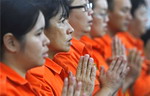
Although ceremonies commemorating the dead still exist due to the long-lasting tradition of filial piety in China, today people mourn their close relatives - generally within three generations - rather than their remote "ancestors". For the majority of people nowadays, Qingming is a time to convey their sadness at their lost loved ones; it has become a time for mourning rather than worship.
Since 2008, Qingming has been a statutory holiday, which is a positive move to preserve Chinese culture, maintain social standards and advocate traditional Chinese moral values. Filial piety and family values, among the various and even contradictory moral values in contemporary Chinese society, are still the ones that have the most consensus. Even though many Chinese traditions have faded away with the passing of time, modern individuals, even most youngsters, still solemnly practice tomb sweeping in some form or other.
But the future will witness more changes in people's mourning rituals during Qingming as Chinese society continues to change, and the increasing shortage of land and population migration will make it more and more difficult for the Qingming ceremony to maintain any vestige of its traditional form. People's mourning behavior will gradually move beyond the restriction of ritual spaces.
For example, some young people are beginning to hold virtual memorial ceremonies online for their beloved departed, instead of making offerings at the gravesite. The change in family structure will also affect the form of ceremony. Before the first single-child generation grows up, even if the nuclear family has become the typical form of the Chinese family (especially in urban areas), tomb sweeping is still a family group activity often involving three generations. Although it's not a major gathering of the clan as it was in ancient times, Qingming is still an important occasion bringing the families of siblings together. However, when the post-1980s generation become middle-aged adults and have to deal with their parents' funeral affairs, China will witness a turning point in the individualization of the mourning ceremony.
The recent adjustment of the family planning policy that allows couples to have a second child if one spouse is an only child, instead of if only both spouses are an only child, which was the case previously, will change this phenomena again. But considering the speed and ways China's society is changing, especially the trend of aging society, it's predicable the mourning ceremony will not return to its former incarnation.
However, it doesn't matter what form the mourning ceremonies of the future take, what really matters is whether we maintain the core values of this ancient tradition: filial piety and family kinship.
The author is a writer with China Daily. wangyiqing@chinadaily.com.cn.


Copyright 1995 - . All rights reserved. The content (including but not limited to text, photo, multimedia information, etc) published in this site belongs to China Daily Information Co (CDIC). Without written authorization from CDIC, such content shall not be republished or used in any form. Note: Browsers with 1024*768 or higher resolution are suggested for this site.
License for publishing multimedia online 0108263 Registration Number: 130349