Managing economic development as well as risks
 |
|
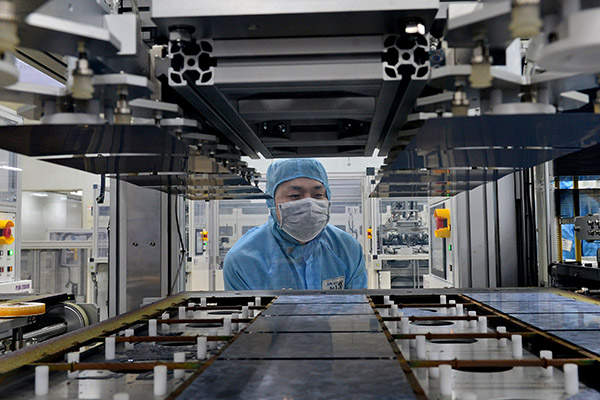
A worker at a plant in Xingtai, Hebei province, Jan 25, 2017. [Photo/Xinhua] |
Still, as China's economic reforms continue, risks need to be addressed, as President Xi Jinping said recently, to cope with corporate over-leveraging, as well as to reduce overcapacity in the real estate and heavy industry sectors.
In the last few decades, the government has always been careful to pay attention to economic signals, including those against potential risks and problems, and carefully planned the structural reforms. The recently concluded annual sessions of the country's top legislature and top political advisory body also took note of the financial risks and adopted measures to tackle them.
Why is this important? Because the debt of non-financial enterprises in China has reached almost 170 percent of GDP by the end of last year, the highest level among leading economies, with State-owned enterprises accounting for more than 70 percent of the total corporate debt. In this context, the government's measures to tackle financial risks should include the gradual removal of implicit guarantees to SOEs and restricting leveraged investment in the assets markets.
China has already made progress on this front. Namely, the guidelines to deepen reforms of SOEs, issued in September 2015, describe six priority areas including aspects like mixed ownership and transitioning to a modern enterprise system. And 68 percent of the central government-controlled SOEs under the State-owned Assets Supervision and Administration Commission of the State Council had introduced non-State managers by the end of 2015, and more than 80 percent of all the SOEs under SASAC have set up or are in the process of setting up a board.
In addition to allowing companies with high debts (especially those in overcapacity industries) to exit the market, the government should also help them restructure, and ensure that the process takes place gradually in order to prevent the waste of valuable resources (which could be better used more efficiently or to make growth more inclusive).
Therefore, the Organization for Economic Cooperation and Development suggests that insolvency procedures of the so-called zombie enterprises could be accelerated to reduce uncertainty and compensate laid-off workers.
Another aspect emphasized by the OECD regards the sharing of the benefits of growth, since China's tax and transfer system remains less efficient than those in other leading economies. For example, many low-income households pay a higher share of their incomes as social security premiums than the richer ones. And workers who are outside the formal labor market are not required to participate in the pension and medical insurance schemes, potentially increasing their financial vulnerability.
Hence, the OECD believes that the authorities should base the calculation of social security contributions of low-income households on their actual incomes, instead of the current system that prescribes a minimum contribution calculated on an imputed value of their earnings equivalent to 60 percent of the previous year's local average wage. The subsequent loss of revenue can be partly offset by the money that can be realized by reforming the individual income tax system, say, by abolishing the tax exemptions that favor high-income households. For instance, the interest received on government bonds or savings in banks, which now is non-taxable income, should be taxed.
All in all, it is important to highlight that the Chinese economy will remain the major driver of global growth, which is good news to the world economy. And once enterprises improve their performance through innovation and entrepreneurship, and the SOE reforms gain pace through exposure to market mechanisms, more jobs will be created and the benefits of economic growth can be shared by all.
Alvaro Santos Pereira is director of Country Studies Branch of the Economics Department, Organization for Economic Cooperation and Development. This article is an excerpt from his interview with China Daily's Wu Zheyu.