 |
|
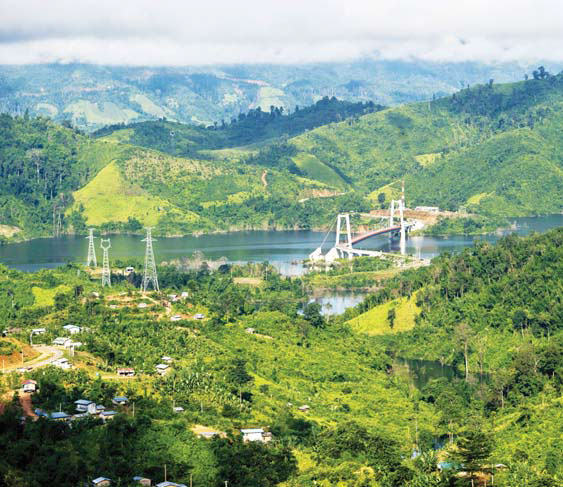
Electricity pylons and a bridge in Myanmar's eastern Shan state. Chinese investment, as part of the Belt and Road Initiative, is improving infrastructure in the country, including roads, rail, energy and telecommunications.[Photo/AFP] |
Hundreds of local striking workers damaged a Chinese garment factory in Yangon, Myanmar, last week. They also took away the personal belongings of Chinese staff and detained seven Chinese staff members from leaving.
After the Chinese embassy in Myanmar lodged a protest with Myanmar authorities, the detained staff were released the next day. According to Myanmar media reports, the incident was triggered by the sacking of a local employee.
Though enterprises funded by investors from Chinese mainland, Taiwan and the Republic of Korea, have often fell victims of labor disputes in Myanmar in recent years, a dispute of last week's magnitude is rare.
The onus is on the Myanmar side to restore factory operations, hold the perpetrators accountable and safeguard the legal rights and interests of Chinese citizens and companies in Myanmar.
As a country thirsty for foreign investment, the Myanmar authorities should obviously do more to cultivate a more stable investment environment and guarantee the property and personnel safety of all foreign investors in Myanmar, including those from China.
Since Myanmar embarked on a democratization process in 2011, profound political and economic changes have taken place in the country. On March 30, 2016, a new government led by Myanmar's National League for Democracy was sworn in, turning a new page in the country's political landscape.
At the same time, China-Myanmar ties have experienced ups and downs, which has prompted some in the West to speculate that China is losing its influence in the Southeast Asian country.
Yet, despite the political changes in Naypyidaw, the fundamentals for friendly ties have not changed.
This well explains why leaders from both countries vowed to carry forward the traditional friendship between the two countries and push their good neighborly ties to an even higher level soon after Myanmar's political transition last year.
Admittedly, there are still some unfriendly sentiments towards China and Chinese investments in Myanmar society, a legacy left over from Myanmar's previous military government. To mitigate these unfavorable sentiments, the Myanmar government should resume the construction of major Chinese-invested projects in the country.
A number of Chinese-invested projects, including the Myitsone Dam which is a colossal hydropower project jointly funded by China and Myanmar, was suspended in 2011. An early resumption of these projects would not only be in China's interests but also Myanmar's interests because these infrastructure projects could contribute to the Southeast Asian country's efforts to revitalize the economy.
Before Myanmar's State Counselor Aung San Suu Kyi paid a visit to China in August last year, Myanmar's new government decided to review all proposed hydropower projects on the Irrawaddy River, including the Myitsone Dam.
The Myanmar side needs to quicken the review process as further suspension of those projects could send a misleading signal to the outside world.
An early resumption of those projects would, instead, help send a strong signal to outside that the Myanmar government is working to translate its words of developing its ties with China into concrete action.
This would also help dispel misunderstandings about Chinese-invested big projects in Myanmar and cultivate a better environment for Chinese investments in the country, contributing to enhancing Chinese investors' confidence in Myanmar and closer bilateral economic cooperation at large.
China is Myanmar's largest investor. Statistics show China's nonfinancial investment in Myanmar in 2016 reached $308.6 million, up 50 percent year-on-year. Considering that there was a major slip in Myanmar-bound Chinese investment in the financial year of 2013 to 2014, Chinese investors are showing their renewed confidence in investing in the Southeast Asian country.
Incidents like that at the Chinese garment factory last week will only dampen this enthusiasm and do a disservice to bilateral economic cooperation.
The author is a senior writer with China Daily



Copyright 1995 - . All rights reserved. The content (including but not limited to text, photo, multimedia information, etc) published in this site belongs to China Daily Information Co (CDIC). Without written authorization from CDIC, such content shall not be republished or used in any form. Note: Browsers with 1024*768 or higher resolution are suggested for this site.
License for publishing multimedia online 0108263 Registration Number: 130349