 |
|
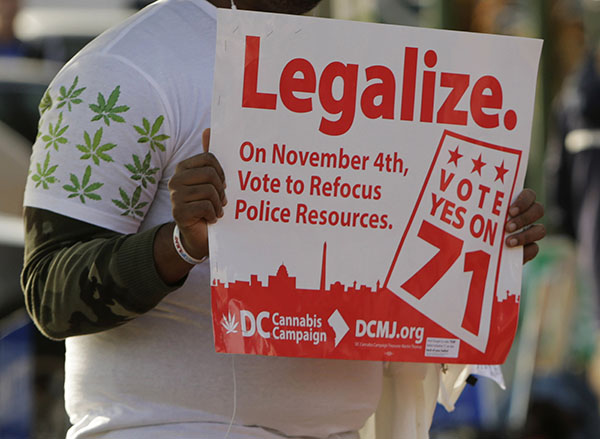
Melvin Clay of the DC Cannabis Campaign holds a sign urging voters to legalize marijuana, at the Eastern Market polling station in Washington, in this November 4, 2014 file photo. [Photo/Agencies] |
A puzzling occurrence to many Chinese visiting the United States in the last four years is that marijuana has been legalized by a growing number of states, and support for its use among the public is also rising.
This is quite a contrast to the fact that most people in China still associate drugs with the country's bitter Opium War in the mid 19th century, a war forced upon it by the British to legalize its opium trade in China.
So far, 29 US states and the District of Columbia have legalized the use ofmari-juana for medical use, and some of them have also allowed recreational use since the states of Colorado and Washington became the first to legalize recreational use in 2012.
A Pew Center survey last October found that 57 percent of US adults said the use of marijuana should be legal, while 37 percent said it should be illegal. The view a decade ago was the reverse, with just 32 percent favoring legalization and 60 percent opposing it.
A Gallup poll found that 13 percent (or 1 in 8) of US adults in 2016 said they were using marijuana, while that number was only 7 percent in 2013.
A US federal law states it is illegal to use, possess, sell, cultivate or transport marijuana. But the federal government has articulated that if a state passes a law to decriminalize it for recreational or medical use, it can do so under the condition that a regulation system for marijuana is in place.
Marijuana, also called cannabis, grass, weed or pot, is listed as a Schedule I sub-stance by the USD rug Enforcement Administration, along with heroin. The DEA defines a Schedule I drug as a sub-stance that has a high potential of being abused and has no accepted medical uses.
The debate about the pros and cons of marijuana is far from over in the US, and it goes far beyond the health and medical realm. A Washington Post report last October said police make more arrests for marijuana possession than for all violent crimes combined.
Barack Obama, the US president, at time of writing, and former presidents Bill Clinton and George W. Bush, along with many other politicians, have all admitted to once using marijuana.
While more US states are likely to legalize marijuana in various forms, it is unknown what president-elect Donald Trump's administration will do about it. His pick for attorney general, Jeff Sessions, is well known for opposing the legalization, saying in last week's confirmation hearing that he "won't commit to never enforcing federal law".
The change in the US has not gone unnoticed in China, especially after the high-profile August 2014 arrest in Beijing of American-born Hong Kong actor and singer Jaycee Chan Jo-ming, son of the well-known martial artist and actor Jackie Chan. Jaycee Chan was found guilty of possessing 3 ounces of marijuana, which was found in his apartment.
Like most countries in the world, possession, sale, transportation and cultivation of marijuana is illegal in China.
In arguing for legalizing marijuana, many Americans have traced its medical use back to ancient China. But for many Chinese, marijuana is a drug and there-fore synonymous with opium, a much more potent substance that the British forced upon the Chinese during the Opium War. The war was widely regarded by Chinese as the start of their country's "century of humiliation".
Such a bitter collective memory means it would be much harder for any prospects of legalizing marijuana in China. In 2014, after the arrest of Jaycee Chan, the People's Daily warned that legalizing marijuana would be a disaster for the nation.
To me, the pungent smell of marijuana increasingly experienced on the sidewalks of Washington is an unpleasant addition to an otherwise beautiful city.
The author is deputy editor of China Daily USA. chenweihua@chinadailyusa.com



The year 2016 marks my second time saying farewell to full-time motherhood and back to "normal".
Copyright 1995 - . All rights reserved. The content (including but not limited to text, photo, multimedia information, etc) published in this site belongs to China Daily Information Co (CDIC). Without written authorization from CDIC, such content shall not be republished or used in any form. Note: Browsers with 1024*768 or higher resolution are suggested for this site.
License for publishing multimedia online 0108263 Registration Number: 130349