 |
|
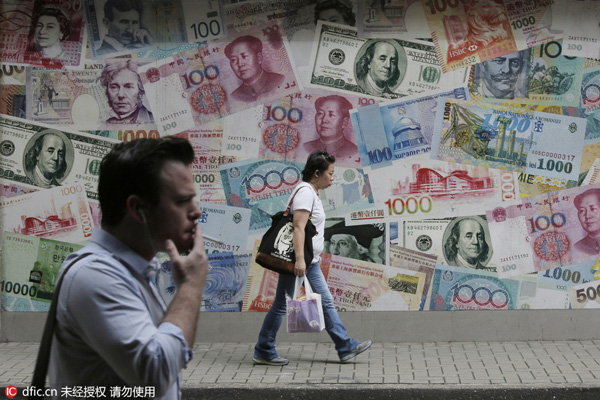
People walk past a money exchange decorated with different currencies in Hong Kong, June 27, 2016. [Photo/IC] |
When describing the condition of the European Union, many are inclined to recite a long list of crises facing Europeans. Apart from the fallout from the Brexit vote, mass migrations of displaced people, terrorism, changes in leadership and other events, they usually claim Europe is still in economic recession.
This is an old story, however.
Going by the many economic figures and predictions, Europeans have reason to enjoy Christmas and the New Year. Put simply, after years of hard efforts to save some countries from bankruptcy, building up its own financial firewall, introducing tighter fiscal and banking regulations and injecting stimulus projects, the EU has left such crises behind.
The latest Organization for Economic Cooperation and Development outlook on the eurozone, which consists of 19 countries, says the economy would grow at an average annual rate of 1.6 percent in the 2016-18 period. The OECD, the World Bank and the International Monetary Fund have all predicted that all the European countries are expected to experience growth, instead of decline, in 2016. And this trend is set to continue.
Even the Greek economy, the original victim of the sovereign debt crisis in the eurozone, has rebounded and is expected to gain some strength in 2017-18 due to structural reforms and China-led foreign investments.
All this has happened against the background of the eurozone's annual average growth rate of a mere 0.8 percent from 2004 to 2013, with 2009 being the worst year when all the EU economies shrank, except Poland, which registered a growth of 1.7 percent.
Although the unemployment rate in the EU is still high-about 8.3 percent-figures from October show the rate has been decreasing month by month over the past couple of years.
Commentators and the media, however, have the habit of raising the alarm unnecessarily. Some have warned that EU could be stuck in a low-growth trap like Japan while others say the worst is still to come.
Such comments do not reflect reality. The EU's stimulating lending measures and investment plans over the past couple of years have lifted it out of the sovereign debt and global financial crises. And despite the other challenges it faces, the EU may embark on a new growth cycle, if other leading economies also manage to keep the growth moving.
As a combination of wealthy and industrialized countries, the EU and the eurozone have enjoyed high per-capita wealth and economic output, and past economic and financial crises have not changed the fundamentals. Given these facts, it's time Europe lowered its expectations by borrowing China's concept of new normal, because it is difficult to keep the economy growing at high speed and reforming its structure at the same time.
China, the largest developing economy, has decided to maintain a stable growth rate of 6-7 percent in the coming years, so the EU, as an advanced economy, should look at an annual growth rate of 2-3 percent, because finding new engines of quality and stable growth is more important than growing at dazzling speed.
Although Europeans seem to have left the economic crisis behind, they cannot afford to become complacent. They have to act swiftly to meet the other challenges Europe faces, so as to prevent them from stifling its economic growth.
More important, the EU must not resort to protectionism. For example, the EU has tightened its trade and investment policies vis-a-vis China after its economy picked up, sending out all the wrong signals.
This is not the time for the EU to apply the brakes but instead to sustain and nurture its growth. It must continue to allow the momentum to gather and be as open as it was when it is in the depths of the global financial crisis from 2008 to 2011 when it joined other global players to rule out any protection measures.
The author is deputy chief of China Daily European Bureau. fujing@chinadaily.com.cn


The year 2016 marks my second time saying farewell to full-time motherhood and back to "normal".

Copyright 1995 - . All rights reserved. The content (including but not limited to text, photo, multimedia information, etc) published in this site belongs to China Daily Information Co (CDIC). Without written authorization from CDIC, such content shall not be republished or used in any form. Note: Browsers with 1024*768 or higher resolution are suggested for this site.
License for publishing multimedia online 0108263 Registration Number: 130349