 |
|
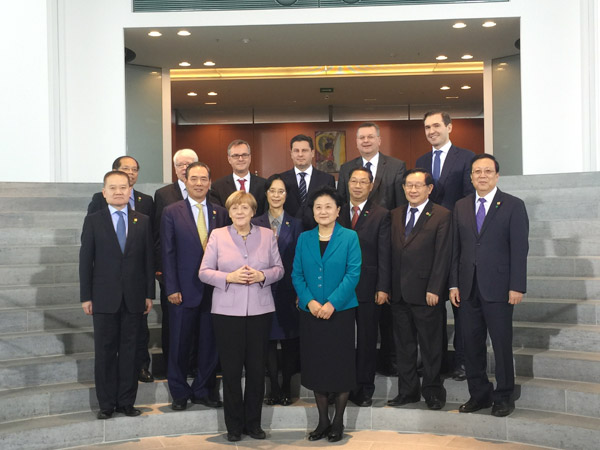
German Chancellor Angela Merkel meets the Chinese delegation before holding talks with Vice-Premier Liu Yandong in Berlin on Nov 25, 2016. [Photo by Fu Jing/chinadaily.com.cn] |
Germany, the European Union's largest economy, took over the presidency of the G20 on Dec 1 and is preparing to host the group's 12th summit in Hamburg next summer, building on the results of the summit in Hangzhou, East China's Zhejiang province, in September.
Germany has already signaled it will expand the G20 agenda by focusing more on African development, climate change, the United Nations 2030 Agenda for Sustainable Development, healthcare and digitalization. This is an encouraging trend.
However, looking carefully at the political landscape in the West it seems the rich countries may once again play a disruptive role in the G20 process.
At the G20 summit in 2008, the leading rich and emerging economies began a process of Western-inspired crisis management to achieve economic stability after the collapse of US financial giant Lehman Brothers. With those goals basically achieved, the G20 became a global platform where other issues such as development, climate change, sustainability, labor and even women's rights are now debated.
The wide sweep of the G20 agenda can be seen in the constructive outcome reached and the commitments contained in the communiqué issued by G20 summit in Hangzhou. In terms of global governance, it is a positive sign when the South and North sit down to coordinate policies for growth, development and prosperity. Germany can learn from these outcomes as it begins its one-year G20 presidency.
But reality is different. Look at what is happening within the G7, whose members comprise the rich, developed member states of the G20. People in Britain voted to leave the European Union in June causing market upheavals. Further turmoil cannot be avoided once the tough negotiating Brexit process begins.
On the other side of the Atlantic, Donald Trump has been elected the next US president, creating huge uncertainties that are making many Europeans extremely nervous. And in 2017, Germany and France will face the challenge of right-wing parties, propagating nationalism and trade protectionism, in national elections that will be held against the backdrop of the continuing migrant crisis and terrorist threats.
Even the EU, with European Parliament President Martin Schulz announcing his decision to run for German chancellorship, faces a possible change in leadership and growing political uncertainty.


Copyright 1995 - . All rights reserved. The content (including but not limited to text, photo, multimedia information, etc) published in this site belongs to China Daily Information Co (CDIC). Without written authorization from CDIC, such content shall not be republished or used in any form. Note: Browsers with 1024*768 or higher resolution are suggested for this site.
License for publishing multimedia online 0108263 Registration Number: 130349