Household registration reality of urban identity
 |
|
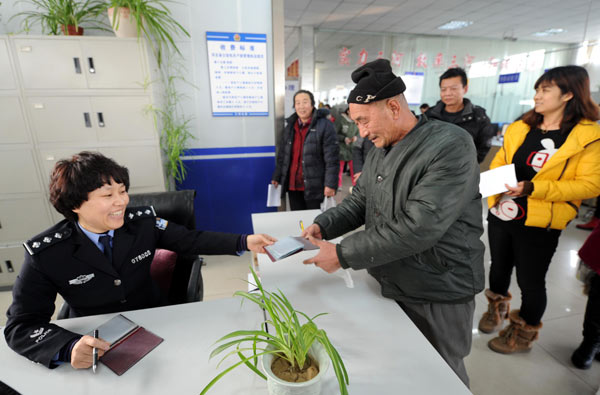
A man's hukou is transferred at a government service center in Sanhe, Hebei province. [Photo/Agencies] |
FOR MANY MEMBERS OF THE MIGRANT POPULATION in Guangzhou, capital of South China's Guangdong province, although they have lived in the city for many years, it is only when they have a local hukou, or household registration, that they finally consider themselves part of the city. Southern Metropolis Daily commented on Tuesday:
The equality of the migrant population with the local one means the former have both the perception and reality of an urban identity. This does not just mean they have a local household registration but also a sense of belonging.
In many countries, an urban identity is as much the result of soft factors as hard ones, since a city's identity generally derives from the lifestyle of its residents and its cultural traditions.
But in China, the roots of urban identity are slightly different. As a result of long-term control of population flows by means of the household registration system, it is this registration that is the generator of an urban identity in China.
There is a wide identity gap between the local population and the migrant population in China's cities, according to the findings of a survey by Sun Yat-sen University. Its survey of seven cities found the local population's urban identity was significantly higher than that of the migrant population.
A similar conclusion was found in a survey of Shanghai residents this summer by the Shanghai Institute of Finance and Law.
Interestingly, it found that 57 percent of non-Shanghai-born respondents said they had feelings for Shanghai, and their feelings for the city were far greater than those who thought themselves Shanghainese.
That the household registration is a key factor in urban identity is not a good thing. The traditional analysis of the social impact of household registration mainly focuses on how household registration affects individual rights, such as access to public services.
In public discussion, few people consider how to integrate the migrating population psychologically into a city.