 |
|
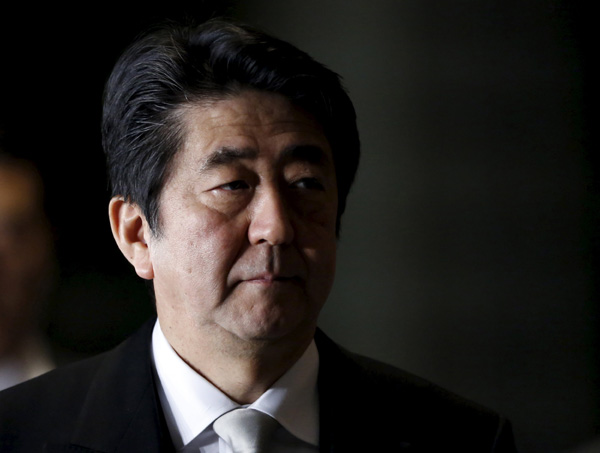
Japan's Prime Minister Shinzo Abe walks into his official residence in Tokyo, Japan, January 28, 2016.[Photo/Agencies] |
Japan is on edge.
The unexpected victory of billionaire businessman Donald Trump in the US election has caused great anxiety in the country.
Prime Minister Shinzo Abe will fly to New York on Thursday to meet the president-elect-h(huán)is predecessors were never so anxious to talk to the winner of a US presidential election before. Abe had actually scheduled a visit to Washington in February to see Hillary Clinton, whom he thought would be the next incumbent of the White House.
The reason for Abe's haste is the billionaire businessman who will be the United States' next commander-in-chief criticized Japan, among other countries, during his campaigning, accusing them of stealing American jobs, freeloading on defense and manipulating their currencies.
He has loudly rejected the Trans-Pacific Partnership agreement that Abe has expended significant political capital to push. The lower house of Japan's parliament has already approved the agreement, which the Abe administration says could eventually add 800,000 jobs and boost GDP by 2.6 percent in Japan.
Trump has also suggested withdrawing US troops from Japan if Tokyo does not pay more for the cost of hosting US military forces.
Tokyo pays nearly 200 billion yen ($1.9 billion) a year, or about 75 percent of the costs, for the 50,000 US troops stationed in Japan. And Japanese Defense Minister Tomomi Inada said on Friday that was "enough".
That stance is perhaps bolstered by the fact that Japan's 30-year nuclear agreement with the US will expire in July 2018. Under the agreement, the US has approved nuclear fuel exports and the use of plutonium in Japanese nuclear power plants under the condition that Japan does not develop a nuclear weapons arsenal.
Up to now, Japan has taken its alliance with the US as the linchpin of its foreign and security policies.
Since taking office in December 2012, Abe has danced to the tune of US President Barack Obama. The two countries revised their guidelines for defense cooperation last year, with Japan ambitious to take on a more robust international role. And Japan's new security legislation, which heralds a historical change in the country's defense posture, took effect in May. The new laws enable Japan to exercise the right to collective defense, such as mobilizing its Self-Defense Forces to defend an ally, namely the US.
The media in Japan have advised Abe to convince Trump of the importance of maintaining the deterrence power of the US military's presence in Japan by playing the China card.
The Japan Times said the US cooperating and coordinating with Asian nations is crucial in dealing with "China's increasing assertiveness" in the South and East China seas.
The Asahi Shimbun said China continues to pursue "aggressive maritime expansion" in the South China Sea and other areas, while the Democratic People's Republic of Korea is forging ahead with programs to develop nuclear arms and missiles.
"If, under such circumstances, Trump pursues foreign and security policy agendas formed and defined by parochial views and haphazard negotiations, the regional order could collapse," the newspaper said, calling Abe to "do his best" to explain convincingly these realities to Trump.
But observers believe that Trump's zero public service experience means the Japanese government's traditional channels with the US Republican Party are useless.
Even worse, the Abe administration is said to have no idea of whom to turn to for access to Trump's inner circle.
James L. Schoff, a senior associate in the Asia Program at the Carnegie Endowment for International Peace, predicted that the worst outcome for Japan would be a sense of strategic abandonment with Trump as president.
This possibility is what is vexing the Abe administration.
The author is China Daily Tokyo bureau chief.
caihong@chinadaily.com.cn

 Will Trump walk the talk on his vow to drain the swamp?
Copyright 1995 - . All rights reserved. The content (including but not limited to text, photo, multimedia information, etc) published in this site belongs to China Daily Information Co (CDIC). Without written authorization from CDIC, such content shall not be republished or used in any form. Note: Browsers with 1024*768 or higher resolution are suggested for this site.
License for publishing multimedia online 0108263 Registration Number: 130349