Clearing local govt debts
 |
|
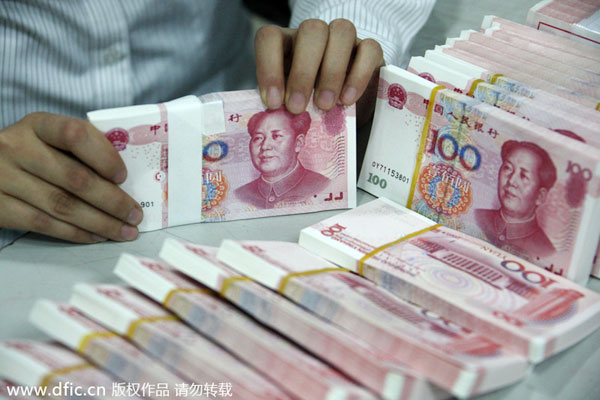
A clerk counts yuan bills at a bank in Huaibei, East China's Anhui province. [Photo/IC] |
A contingency guideline for handling local government debts, published on Monday by the State Council, China's Cabinet, works to ensure nationwide fiscal health.
The document defines four grades of debt risks and sets out corresponding emergency responses while setting specific terms for holding local governments accountable if those risks materialize.
And, just as important, it sends a timely and unambiguous message that the central government will not bail out local governments if the latter borrow irregularly or recklessly.
It has been an unspoken belief held by many, including some local policymakers, that if local governments go insolvent the central government will step in to bail them out. Monday's guideline serves to rule out that scenario, thus closing the moral hazard loophole.
Local government debt has piled up after the borrowing binge for investment in response to the 2008 global financial crisis, and it totaled 16 trillion yuan ($2.34 trillion) at the end of 2015.
However, together with the central government debt, that is still less than 40 percent of the country's GDP and markedly lower than the 60-percent alert line adopted by many advanced economies. Moreover, China is reducing the local debt through debt replacement and restructuring. The ratio is set to drop in the coming years.
But, given its sheer amount, local government debt constitutes a real-although not yet dangerous-challenge that China cannot afford to ignore. The latest guideline, in this sense, serves as a firewall against the potential risks and warns local governments that they must think twice before engaging in any irregular borrowing activities.
China's local government debt problem will not be solved soon, but so far, it has been under control, thanks to the fiscal rebalancing measures introduced in recent years.
The latest move is part of the ongoing reforms aimed at strengthening fiscal discipline and improving budget control to maintain financial security. Properly implementing it and sticking to a balanced budget strategy can ensure continued fiscal health.
- China introduces emergency plan for local govt debt risks
- Court blacklist derails debt defaulters
- China's debt risks controllable, challenges remain: official
- China Construction Bank eyes over 50 debt-to-equity swaps
- CCB sets up debt-to-equity swap to reduce Yunnan Tin's leverage
- Implementation of guidelines key to debt-to-equity swaps programs' success: IMF senior official
- Debt-equity swap's impact in focus