 |
|
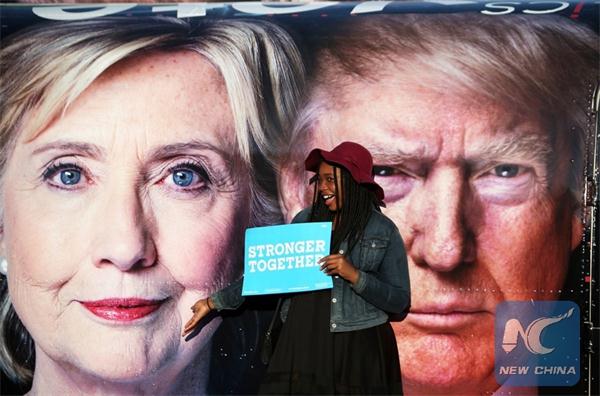
A girl poses for photos with Hillary Clinton and Donald Trump posters at Hofstra University in New York, the United States on Sept. 26, 2016. [Photo/Xinahua] |
The United States presidential election is now in full swing, with both parties going all out in a feverish effort to gain the upper hand. The 2016 vote is watched very closely all over the world, because whoever occupies the White House next January is going to face a fast-changing world with multiple challenges crying out for active American involvement and a more isolationist and inward-looking America unwilling to take on the role of "world policeman".
Before we delve deeper into the impact of the election on China and US-China relations in the coming years, there is a need to offer a brief analysis of what insight this election process has brought us into the American phyche.
First and foremost, it has laid bare the rising populist sentiments that are oozing out of every pore of American politics both domestic and international. One example is the Republican candidate Donald Trump whose fiery words on immigration and Muslims has won him high approval ratings even though those words are obviously on the extreme end of populism. Three Republican candidates, Trump, Cruz and Carlson, are considered politically extreme but have consistently won as a group over 50% support among Republican voters based on recent polls. It shows that voters are rejecting traditional candidates.
What it reveals is that men-on-the-street in America are simply tired of traditional politics and politicians. The fact that Jeb Bush falls behind Trump therefore comes as no surprise. Populist sentiments reflect the unhappiness ordinary people have against status quo where American economy is still under the shadow of financial crisis and slow recovery as well as enfeebled responses of the American government in the face of global challenges. To put it in perspective, they represent the frustration and anxiety of American people feel about the changed and still fast changing world they live in. The American supremacy and sense of safety both physical and economic is threatened. That's the essence of what people fear.
Here comes China, whose economic growth and military modernization in recent years represents, to American people, a world that undergoes rapid changes and evolves to a multipolar one where the US is no longer being able to call shot on everything. The resentment against globalization is on the rise. Overall strategic retrenchment and an emphatic shift to focus more on China are taking place simultaneously. "Scapegoating" China is inevitable. "China has taken jobs away from American workers". "China is manipulating its currency to gain advantage in trade". "China is being aggressive in the South China Sea and trying to drive the US out of the Western Pacific". The list of complaints can go on and on. It doesn't matter whether those accusations and complaints are true or not to American politicians and voters as long as they have "election value". For instance, the renminbi has appreciated against the US dollar to the tune of 30% since 2008, but voices are still strong in America calling for the RMB to appreciate further.
We all know from experience that China-bashing is common and "cost-free" in US elections. This time around is no different. What is different is that while without agreeing to the concept of "G2", there is a broad recognition that the US and China are the two major powers in today's world. It is no hyperbole to say that nothing gets done without close cooperation between the two nations, be it climate change, energy security, non-proliferation of WMD, etc. In this connection the US election does have an impact on China and US-China relations as noted by Robert Manning, who said the US-China relationship enters "dangerous waters" in 2016.
What can be done to counteract the negative spillover from the US election this year?
On the one hand, there need to be more cooperative actions from both sides to reinforce the relationship. Climate change is one, cooperation in the Middle East is another. To quicken the pace of negotiation on BIT is definitely useful with emphasis on shortening the "negative list". The US-China relationship is simply too important for both nations not to make extra efforts in election years to make it stronger in the face of increased headwind.
On the other hand, we ought to stay calm and ready to meet any possible frictions and challenges in close coordination and consultation to minimize damage to the bilateral relations. We have to understand that "China-bashing" is more words than actions. Any new administration once in the White House will be more realistic and down-to-earth in its China policy as determined by shared interests of both nations worldwide.
In reality, China has not been the key issue in the election so far despite some rhetoric by candidates from both parties. To prioritize the issues that voters care about most, the threat posed by terrorist organizations such as IS ranks at the top of the list. Next comes illegal immigration because as of now there are between 12 million to 20 million illegals residing in the US depending on how you estimate them. Further down the list is tax policy. As is often quoted, "There are two things certain in life. One is death and the other is taxes". Another concern that comes before China is the dangerous situation in the Middle East. So you can see clearly that China figures rather low on this "worry list" in the minds of American voters.
Of course what is said above should not give us complacency that we should just go home and rest, letting matters taking their own courses. Our bilateral relations are fundamentally solid and we should observe what happens in the election closely, ready to act in a timely fashion once something goes wrong. At the same time we need to look ahead and have close contact with both US political parties to engage in the formulation of their China policies. President Obama is in his last year and eager to leave a foreign policy legacy. US-China relations being on even keel, I believe, should be one of the most important legacies President Obama can leave behind.
The author is vice-minister of the Overseas Chinese Affairs Office of the State Council, and former vice-minister of the Chinese Ministry of Foreign Affairs.
Courtesy: chinausfocus.com



Copyright 1995 - . All rights reserved. The content (including but not limited to text, photo, multimedia information, etc) published in this site belongs to China Daily Information Co (CDIC). Without written authorization from CDIC, such content shall not be republished or used in any form. Note: Browsers with 1024*768 or higher resolution are suggested for this site.
License for publishing multimedia online 0108263 Registration Number: 130349