 |
| CAI MENG/CHINA DAILY |
For decades, Beijing, as the capital of China, has been expanding, with the number of ring roads increasing from two to six and the population reaching 21.7 million in 2015. Such rapid expansion has caused multiple problems, such as overcrowded communities, severe traffic congestion and a worsening environment. It is now urgent that the government should find prescriptions to cure such urban diseases.
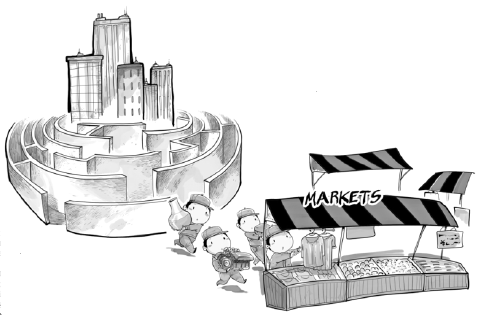
One of the prescriptions the central government has come up is relocating the Beijing municipal government, industrial plants and other functions not related to its role as the nation's capital out of the city center.
Many "low-end" industries are to be relocated according to a plan released in April last year, and the Beijing authorities have followed the central government's lead by announcing that around 200 markets are also to be relocated from the central area of Beijing.
In fact, the urban planners are involved in almost the whole process of moving industries out of the city center at present. The urban authorities conduct research and then make decisions about which industries are to be moved out and where they are to be moved to.
That mode has both advantages and disadvantages. One advantage is that by making the relocation decisions, the authorities are sending a clear signal to the whole society of which industries they want to survive. This in turn prompts expectations that the industries moved out of the city center according to the government's plan will receive policy support to help them through their relocation. As a result, enterprises and businesses will invest in the areas where these industries are being relocated, which will help these areas prosper and become new urban centers.
But there are disadvantages, too. In a market economy, it is not the government but the enterprises themselves that best know what they need to thrive and so can best make the decision about where they should be relocated. If the relocation process is dominated by the government it will be irreversible, and sometimes, even though the government wants an industry to survive, it does not fully know what is required for them to do so.
Therefore it is necessary for the authorities to consider allowing the market to have a bigger role in relocation decisions. It needs to study the industries and their markets, so as to clearly predict whether the industries will prosper after being moved out and which areas are most suitable for them.
The author is an assistant researcher at the Institute of Population and Labor Economics, Chinese Academy of Social Sciences.



Copyright 1995 - . All rights reserved. The content (including but not limited to text, photo, multimedia information, etc) published in this site belongs to China Daily Information Co (CDIC). Without written authorization from CDIC, such content shall not be republished or used in any form. Note: Browsers with 1024*768 or higher resolution are suggested for this site.
License for publishing multimedia online 0108263 Registration Number: 130349