 |
|
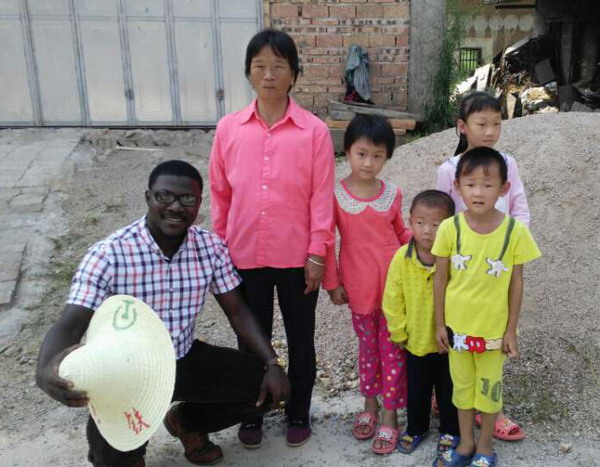
The photo shows the author takes a photo with the local people in Ruijin, Jiangxi province. [Photo provided to China Daily] |
It might not be the most popular county in China. It hasn't got the buzz and shine of some of China's finest cities. But today Ruijin county, the small farming community in East China's Jiangxi province, enjoys a lot of tranquillity compared to the period when it came under siege right before the historic Long March.
The town today is as peaceful as most farming communities in China, where visitors are warmly welcomed by friendly inhabitants to a serene atmosphere and pollution-free environment. Like most rural communities, Ruijin is devoid of the daily chaos and frenzied atmosphere in cities across China. The warmth of the people resonates well with other peasant communities across the mainland. It is a gem in its own right. With hills and lush vegetation the county boasts of hosting some of the founding fathers of the People's Republic of China.
As part of a group of foreign visitors to the county who traveled a week ago to commemorate the 80th anniversary of the Long March, I discovered another part of rural China. We were greeted with fruits, nuts, fried fish and
locally brewed wine to wash it down. It was there I discovered I was at the epicentre of China's Great Revolution as locals shared stories from the siege.
Although most of the sites and buildings have gone under some form of renovation, there were still glimpses of what the area looked like during the period the Red Army camped there. We visited two museums where items belonging to leaders and soldiers of the revolution are carefully preserved. They include photos, bags, letters, old currencies and furniture.
As locals and guides shared stories of the revolution with us, I observed how passionate they were about the events that occurred as the army embarked on the Long March. One key quality that kept echoing in the stories was the collective will of the soldiers to keep moving, even when it looked impossible to continue the march. According to them, what kept the troops moving was the enormous assistance they received from villages they came across. I did liken that to the same warm reception we received upon arrival at Ruijin. To some extent I found the ideal meaning of communism. I found that the principle of communism, to my understanding, is that being each other's keeper starts with accepting others into your fold as equals.
I believe this resonates well with China's opening up policy - that is, to be a friendly global citizen. To let people of other cultures visit and interact with Chinese nationals, do business and vice versa. As I wrote in an earlier article, the spirit of the Long March still continues today as the Chinese nation fosters friendly bilateral relationships with countries in all regions across the globe. It is championing peace and self-empowerment in war-torn countries and providing humanitarian assistance in regions where Western aid is dwindling.
I believe that is part of the bigger social philosophy of making the world more and more a global village, where no matter the distance between nations, we all agree on the survival and triumph of the human race to move into the next century together as one.


Colombian coffee has a story that I admire and use in my lectures and the reasons are the ones listed above. Congratulations!


Copyright 1995 - . All rights reserved. The content (including but not limited to text, photo, multimedia information, etc) published in this site belongs to China Daily Information Co (CDIC). Without written authorization from CDIC, such content shall not be republished or used in any form. Note: Browsers with 1024*768 or higher resolution are suggested for this site.
License for publishing multimedia online 0108263 Registration Number: 130349