|
 |
|
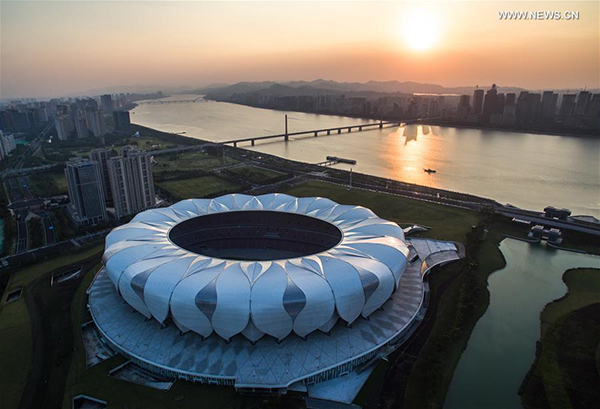
Photo taken on Aug 25, 2016 shows the Hangzhou Olympic Sports Center in the Binjiang district of Hangzhou, capital of East China's Zhejiang province. Hangzhou is the host city for the G20 Summit.[Photo/Xinhua] |
As China assumes the G20 leadership, the prospect of global “protectionism” is on the rise and the stakes could not be higher for cooperation and major structural reform. Without continued investment and trade, secular stagnation in advanced economies and growth deceleration in emerging economies will continue to broaden.
Since 1980, global economic integration accelerated dramatically until the onset of the financial crisis in the fall of 2008. After years of secular stagnation in major advanced economies and deceleration of growth in large emerging economies, modest signs of recovery have prompted international observers’ hope for the revival of globalization.
In the absence of broad policy acceleration following the G20 Summit in Hangzhou, China, such hopes may amount to hollow pipe dreams.
Massive monetary stimulus, but no pickup in trade and investment
At the peak of globalization, the Baltic Dry Index (BDI) was often used as a broad barometer of international commodity trade and as a leading indicator since it seemed to reflect future economic growth. The index soared to a record high in May 2008 reaching 11,793 points. However, as the financial crisis spread in the advanced West, international trade collapsed in the emerging East. Barely half a year later, the BDI had plunged by 94 percent, to 663 points; lowest since 1986.
As China and other large emerging economies chose to support the ailing advanced economies through the G20 cooperation, major economies in North America and Europe pledged accelerated reforms in global governance, while launching massive fiscal stimulus and monetary easing. These factors caused the BDI to rise to 4,661 in 2009. But as promises of reforms were ignored and stimulus policies expired, the BDI bottomed out at 1043 in early 2011, coinciding with the European sovereign debt crisis.
In the past half decade, advanced economies have sustained a semblance of stability, but only by relying on historically ultra-low interest rates and massive injections of quantitative easing; today QE measures exceed $12 trillion, some $10 trillion in negative-yielding global bonds, and there have also been 660 interest rate cuts since the collapse of Lehman Brothers in 2008. Intriguingly, these huge shifts are not reflected by the BDI, which has continued to stagnate. It reached a historical low of 290 last February oscillating in upper-600 point range today – amid the global crisis levels.
Optimists argue that the index reflects poorly on globalization because it is a better indicator of international commodity trade than global economic integration. And yet, the indicators of global investment and trade herald even gloomier prospects.

Copyright 1995 - . All rights reserved. The content (including but not limited to text, photo, multimedia information, etc) published in this site belongs to China Daily Information Co (CDIC). Without written authorization from CDIC, such content shall not be republished or used in any form. Note: Browsers with 1024*768 or higher resolution are suggested for this site.
License for publishing multimedia online 0108263 Registration Number: 130349