 |
|
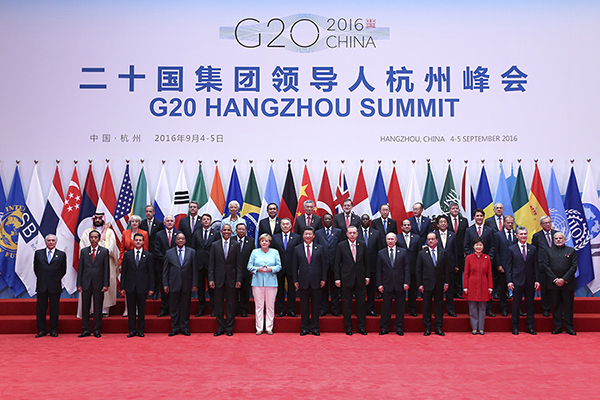
Chinese President Xi Jinping and other leaders of the Group of 20 (G20) members, some guest countries and international organizations pose for a group photo ahead of the opening ceremony of the G20 summit in Hangzhou, capital of East China's Zhejiang province, Sept 4, 2016.[Photo/Xinhua] |
Delivering a speech at the inauguration of the two-day G20 Summit on Sunday, President Xi Jinping emphasized that all G20 members "face the problems squarely" and deliver "real action" not "empty talk" as they seek to resuscitate the global economy. The prescription, as he said in his Saturday speech at the B20 Summit, lies in the joint efforts to build an innovative, open, interconnected and inclusive world economy.
Although China stands at "a new starting point", it remains committed to deepening reforms in an all-round manner, pursuing an innovation-driven development strategy and green growth, delivering more benefits to the people, and increasing its interactions with the rest of world, Xi said.
Xi's two keynote speeches are perfect examples of China's increasing contributions to global economic governance. In other words, the country is using its pursuit of reform and opening-up to add fresh momentum to globalization, as well as the structural reform of the world economy.
Fifteen years after it joined the World Trade Organization, China has completed the process of integrating into the global market; China and the rest of the world are today highly interdependent. The just concluded G20 Summit in Hangzhou, East China's Zhejiang province, was China's latest attempt to provide both tangible and intangible public good for the international community.
Since the global financial crisis broke out in 2008 China has been the most powerful locomotive of the world economy, contributing about one-third of the post-crisis global growth. That is almost double the contribution of the United States, the world's largest economy.
To facilitate the implementation of the Sustainable Development Goals agenda and ensure they are achieved by 2030, as proposed by the United Nations, Beijing is making preparations for the Assistance Fund for South-South Cooperation and will contribute $2 billion to it in the initial stages. It will also keep investing in less developed countries, while exempting the least developed countries from repaying the debts due at the end of last year.
On the institutional front, the Beijing-led Belt and Road Initiative, Asian Infrastructure Investment Bank and BRICS New Development Bank can play important parts in optimizing global governance. The AIIB has proposed a new approach-of lean, clean and green governance-and the Belt and Road programs are aimed at improving regional connectivity in order to promote peaceful cooperation, inclusiveness and mutual benefit.
High expectations have been placed on China as the US implements its "rebalancing to Asia" strategy and the European Union faces multiple crises-from rising terrorist attacks to lackluster growth and the influx of refugees.
China is expected to live up to its reputation as G20 chair for this year by cooperating with other members to make global governance sustainable and efficient, especially because of the rising anti-globalization wave even in the West. For example, Donald Trump, the Republican candidate for the US presidential election, has vowed to impose unreasonably high tariffs on Chinese goods if elected to the White House, and blamed globalization for unemployment and the security problems in the US. And he is not the only Western politician who thinks that way.
In such a political and economic backdrop, the G20 Summit has endorsed efficient global governance so that some developed economies don't relive the past of the G8 governance, which is partly responsible for the fragmented world trade order. Xi's speeches at the G20 and B20 summits have made the global governance mission clear. And the ratification of the Paris Climate Agreement by China and the US in Hangzhou on Saturday and their recent bilateral deals point to a promising start for the fulfillment of that mission.
The author is a professor of international relations at Renmin University of China.

Copyright 1995 - . All rights reserved. The content (including but not limited to text, photo, multimedia information, etc) published in this site belongs to China Daily Information Co (CDIC). Without written authorization from CDIC, such content shall not be republished or used in any form. Note: Browsers with 1024*768 or higher resolution are suggested for this site.
License for publishing multimedia online 0108263 Registration Number: 130349