 |
|
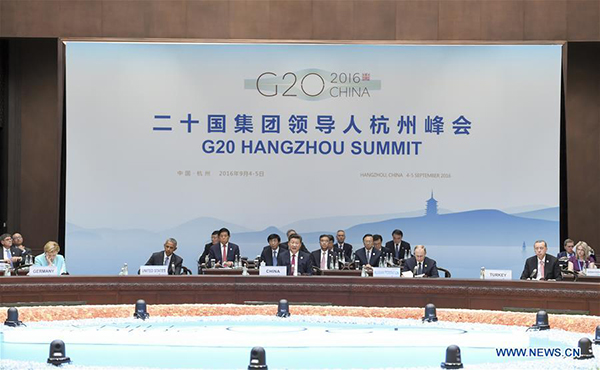
Chinese President Xi Jinping presides over the opening ceremony of the Group of 20 (G20) summit in Hangzhou, capital of east China's Zhejiang Province, Sept 4, 2016. [Photo/Xinhua] |
The ceremonies, handshakes, meetings and speeches, banquets and performances of this year's G20 Summit have now come to an end.
In fact, they ended on Monday after the leaders of the world's 20 major economies met in Hangzhou, East China's Zhejiang province, and a long list of agreements were signed.
But these were not the be-all and end-all of the 2016 G20, as it is likely to have a lasting legacy in international relations, with China leaving its stamp on the G20 as a mechanism to coordinate future actions by the world's leading economies.
China's contribution to the 2016 G20 has been significant in two ways.
First, China has demonstrated unswerving commitment to globalization, more specifically to defending free trade and cross-border investment and business cooperation, despite the fact that it can no longer easily increase its own exports by relying on low-cost labor, and that many processing operations formerly based in China have relocated elsewhere.
Amid growing calls for protectionism worldwide, pessimism about the future, and fear of sharing opportunities with foreigners, China understands that it must set an example by working with other countries to defend the existing global market system.
Just as President Xi Jinping told the delegates at the Business 20, a sideline session of the G20 Summit, on Saturday, rather than overturning the existing system, what China wants is to expand the global market system, to make it include more nations, more workers and more entrepreneurs.
China has also cautioned against attempts to seek self-protection, and politically defined small-circle games, since they tend to rewrite the rules for the global system and worsen the problems plaguing the world economy. On Sunday, Xi again called on the G20 members to continue to promote the liberalization and facilitation of trade and investment.
Second, China's contribution has also been significant in the way the G20's agenda has been aligned with the long-term goals and programs set out by the United Nations. China has contributed substantial content to affect this, including its efforts to nurture cooperation among the emerging market economies and inviting more leaders from developing nations to participate in the G20 process, as well as the proposal for a common e-commerce platform for small and medium-sized enterprises across the world.
To brave the rough waters of the world economy and start a new journey for future global growth, the G20 should not only help the world coordinate efforts to deal with emergencies, as was its original purpose following the onset of the global financial crisis, it should also focus on long-term governance. It should address both the symptoms and root causes of the world's economic problems with real actions, so as to spread opportunities where there are few or none.
In anti-globalization, anger and divisiveness hold sway. Globalization, on the other hand, requires people from different countries to exchange views, compare notes and learn from one another.
However, the G20 members can do more than just talk. They can generate more trade and cross-border investment deals, showcase more innovations, provide more services, and extend help to more poor people and under-developed nations. In the process, the G20 can become more important by finding "a direction and a course for the world economy with a strategic vision", as Xi has urged. In this way it can help realize people's common aspirations for sustainable, balanced and inclusive growth.

Copyright 1995 - . All rights reserved. The content (including but not limited to text, photo, multimedia information, etc) published in this site belongs to China Daily Information Co (CDIC). Without written authorization from CDIC, such content shall not be republished or used in any form. Note: Browsers with 1024*768 or higher resolution are suggested for this site.
License for publishing multimedia online 0108263 Registration Number: 130349