 |
|
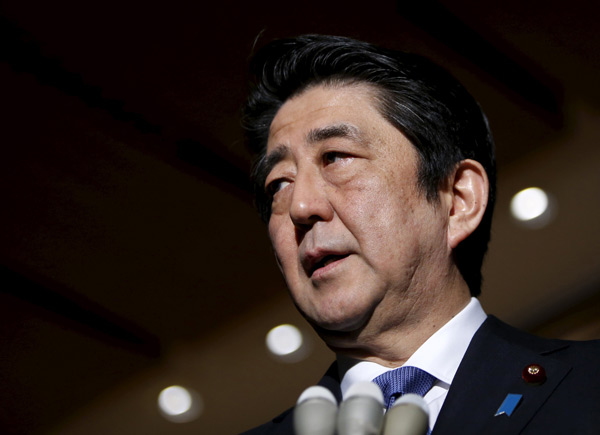
Japan's Prime Minister Shinzo Abe speaks to reporters at Abe's official residence in Tokyo, Japan, January 28, 2016.[Photo/Agencies] |
When Japanese Prime Minister Shinzo Abe committed $30 billion to African infrastructure development, it was with the intention of competing with China for influence there.
When the government of Japan decided to boost military spending and maritime law enforcement, China was the reason.
When the Republic of Korea chose to deploy THAAD, the United States' Terminal High Altitude Area Defense anti-missile system, Chinese missiles are among the birds that the US stone is being aimed at.
When the US cozies up to Vietnam and India, or President Barack Obama visits Laos, China is the imaginary rival in mind.
Yet when China upgrades its defense capabilities in response, it is apparently viewed as a threat to everybody else, in the region and beyond.
Like it or not, an arms race seems to be in the making across East Asia, which reminds people of the Cold War era.
With more and more countries being dragged in for fear of real or perceived threats, the region is on a dangerous path toward becoming a giant powder keg.
Some stout-minded strategists keep fanning fears of the worse-case scenario, and war or even an ever-escalating arms race would put an abrupt end to Asia's story of enviable growth.
But it has not taken a war to put the whole region at odds with one another.
With Beijing, Seoul and Tokyo bogged down in endless conflicts over history and territory, regional economic integration, once a hot topic among the three, now sounds hollow. Pyongyang, on the other hand, has developed unprecedented will to pursue its nuclear ambitions.
Chinese, Japanese and ROK leaders may eventually maneuver meetings on the sidelines of the upcoming G20 summit in Hangzhou. But even if they do manage the "sincere dialogue" that United Nations Secretary-General Ban Ki-moon anticipates, finding the path to denuclearization remains slim.
Yet Ban has voiced again his hope that "the region will move beyond long-standing differences, border disputes and conflicting interpretations of history", because those are the very reasons for where it now stands.
East Asia needs to break the deadlock.
If the Hangzhou meetings take place, they will come at the right time, because they will serve as crucial first steps toward thawing the frozen ties.
We have not lost hope about the common future the East Asian three had once envisaged together, because they seem willing to sit down and talk.

Copyright 1995 - . All rights reserved. The content (including but not limited to text, photo, multimedia information, etc) published in this site belongs to China Daily Information Co (CDIC). Without written authorization from CDIC, such content shall not be republished or used in any form. Note: Browsers with 1024*768 or higher resolution are suggested for this site.
License for publishing multimedia online 0108263 Registration Number: 130349