 |
|
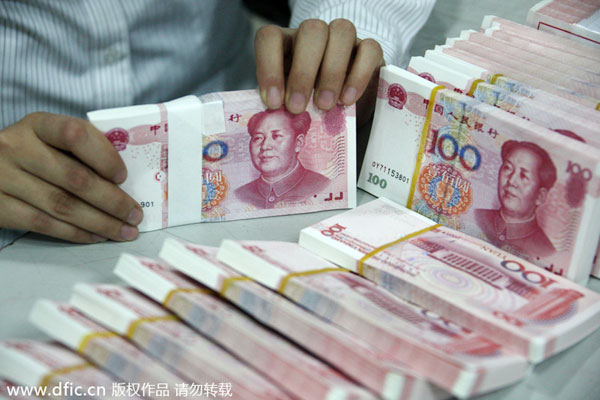
A clerk counts yuan bills at a bank in Huaibei, East China's Anhui province. [Photo/IC] |
When we talk about the health of an economy, we focus on macroeconomics, which deals with the performance, structure, behavior and decision-making process that deal with the growth, inflation and employment (or unemployment). We also take into consideration microeconomics that studies the behaviors of individuals and enterprises in deciding the allocation of resources, as well as the effects of a country's economic policies. Amid all this economics jargon (for lay individuals), the role of the informal economy gets lost.
Unwittingly, the latest population data of Beijing, Shanghai and Guangzhou, China's three major metropolises, shed some light on the informal economy (or sector) and people engaged in it. The population data of the three cities for the first half of the year show the number of residents in central Beijing declined and the growth rate in Guangzhou slowed. Then comes the disturbing part of the data: those moving out of the metropolises are mainly poorer residents, or those working in the informal sector.
The moving out of poorer residents, or "low-end population" as some media outlets have humiliatingly described them, is no big news, right? Wrong.
The popular perception is that people living at the lower levels of society contribute little to nothing to a country's economic development. Nothing could be farther from the truth, for without the valuable contribution of these people, a society (especially modern society) simply cannot function. Imagine a city without construction workers; vegetable, fruit, fish and meat vendors; barbers; garbage collectors; street cleaners, small stall and kiosk owners; and housemaids?The informal sector (or the informal economy, to use a term coined by British economist Keith Hart in 1971) comprises "half to three-quarters of all non-agricultural employment in developing countries", which includes China, says the International Labour Organization. One cannot and should not generalize the quality of informal employment, but most often it "means poor employment conditions and is associated with increasing poverty". Informal employment means "lack of protection in the event of non-payment of wages, compulsory overtime or extra shifts, lay-offs without notice or compensation, unsafe working conditions and the absence of social benefits such as pensions, sick pay and health insurance". The sad truth is that, women, migrants and other vulnerable groups of workers "excluded from other opportunities have little choice but to take informal low-quality jobs".
Yet they contribute a handsome percentage to the gross domestic product, and their contribution can be gauged from the fact that up to 85 percent of the working population in India is engaged in the informal sector. And in urban China, according to global network Women in Informal Employment: Globalizing and Organizing, about 36 percent of women and 30 percent of men work in the informal sector.
The moving out of poorer residents from big cities in China, therefore, cannot be good news. It points to the inadequacy, if not failure, of the social welfare and security systems. Perhaps the problems of finding a house to live in and get their children admitted to schools are forcing poorer people to move out of big cities. But this is neither good for urban development nor social harmony. An ideal city should provide enough space and opportunities for all to leave in relative comfort and with dignity.
The reverse migration, from cities to villages and towns, is particularly bad news in times of booming e-commerce, because soon there could be a shortage of couriers to deliver online shoppers' packages.
Parallel economy is much derided term, for it denotes the part of economy run on black money or ill-begotten wealth. But the "parallel economy" that the informal sector sustains to boost the overall economy of a country deserves better treatment-and the people engaged in it deserve their place in cities.
The author is a senior editor with China Daily.
oprana@hotmail.com


In our daily life, more and more loanwords appear and change our habits in Chinese expression. Loanwords sound very similar with their original English words, and the process of learning them is full of fun to foreign students.

It has been a while since I've contributed to this Forum and I figured that since now I am officially on summer holiday and another school year is behind me I would share a post with you.
Copyright 1995 - . All rights reserved. The content (including but not limited to text, photo, multimedia information, etc) published in this site belongs to China Daily Information Co (CDIC). Without written authorization from CDIC, such content shall not be republished or used in any form. Note: Browsers with 1024*768 or higher resolution are suggested for this site.
License for publishing multimedia online 0108263 Registration Number: 130349