 |
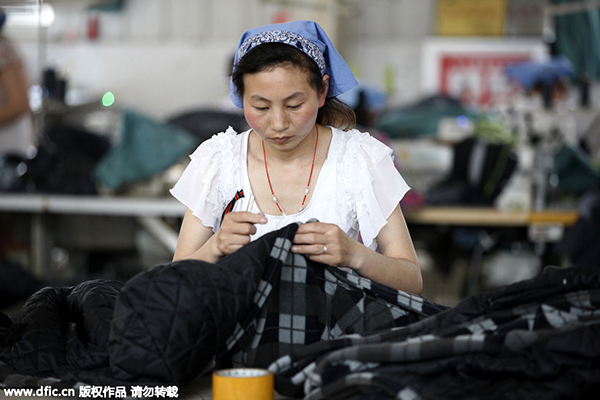
| A female Chinese worker sews clothes at a garment factory in Huaibei city, East China's Anhui province, June 1, 2015. [Photo/IC] |
Anxiously, the world held its collective breath when China announced its 2016 second quarter GDP growth rate, and then collectively exhaled with great relief, for it was 6.7 percent, the same as in the first quarter. The steady growth, slightly beating forecasts, signaled that China's economy is well and on course. Stock markets worldwide need not panic.
The initial anxiety and the subsequent relief are both misguided. At best, GDP growth rates tell only part of China's economic story.
Consider the widespread displeasure over China's slowing growth. How terrible is this? Ten years ago, in 2006, when China's growth rate was a robust 12.7 percent, everyone was happy-count on China to drive world economic growth. Now everyone is on edge about China. But consider this: the GDP base is far bigger. In 2005, China's GDP was $2.3 trillion, and 12.7 percent growth meant an increase of less than $300 billion in 2006. Fast-forward 10 years. In 2015, China's GDP was $11 trillion, and 6.5 percent growth would mean an increase of over $700 billion in 2016-more than twice the absolute amount the economy grew in 2006 when the growth rate was that happiness-engendering 12.7 percent. And since China's population in 2016 is only marginally more than it was in 2006, the absolute amount of GDP growth per capita will be well more this year than it was a decade ago.
That's the good news. But there's complexity, pulling in the opposite direction. What are the components of the growth rate? What sectors are driving it? Investment looms large, so we must ask: How productive are those assets being formed? Massive industrial overcapacity is China's most serious economic impediment. Debt-fueled investments in fixed assets-particularly via government stimulus programs (needed for economic stability)-h(huán)ave rendered some investments unproductive or even counterproductive (they cost money to maintain).
While we cannot know in real time how much unproductive assets are embedded in each year's GDP growth rate, we do know for sure that some of the growth of the past years now sit as overcapacities-coal, iron, steel, cement, glass, heavy equipment, chemicals and housing.
So, on the one hand, the GDP growth rate on a much larger base continues to impress, but on the other, some of that growth is unproductive. Yet there is real growth in consumer products, e-commerce and service industries.
It is difficult to figure out what is really going on.
Obviously, we need GDP growth rates for standardization and benchmarking, but we should not deify them. It's no surprise that they dominate discourse. GDP growth rate is a simple, single number, seemingly easy enough to understand. That's its power. That's also its problem.
How else to assess the economy? I follow China's national policies, seek indicators to discern progress (or not).
Supply side structural reform is critical for reducing overcapacity and corporate debt. Progress in the former could be assessed by, say, an increasing number of corporate bankruptcies-closing down "zombie" enterprises would be a good thing, not a bad thing. It's no secret that some State-owned enterprises are moribund, and so a leading indicator that the government is willing to make hard choices and endure short-term pain to achieve long-term gain would be an uptick in the number of SOE bankruptcies. Similarly, progress in reducing corporate debt would be an increase in debt-for-equity swaps.
Another indicator is the percentage of non-performing loans (NPL) issued by banks, largely to SOEs. No one takes seriously the official NPL rate of about 1.5 percent, which is based on narrow definitions. Analysts estimate the real NPL rate to be between 10 percent and 20 percent. To me, a positive indicator of economic progress would be an increase in officially reported NPLs, because it would mean that the government is ready to clean up the financial system, which is necessary for sustainable growth.
I also focus on China's overarching guidelines for economic and social transformation. Put forth by President Xi Jinping, the Five Major Development Concepts are the highest-level drivers of national policy: innovation, coordination, green, openness and sharing. For each, various metrics can be tracked. None are perfect. All are useful. Innovation: R&D expenditures (as a percentage of GDP), patents, new technology products and companies. Coordination: differentiated economic plans among integrated geographic regions (heretofore competitive). Green: reports from environmental NGOs. Openness: data from China's free trade zones, such as shrinking negative lists (industries off limits). Sharing: reductions in urban-rural imbalances, lower Gini index (test of inequality).
So, take note of the quarterly GDP, sure, but watch other indicators as well.
The author is a public intellectual, political/economics commentator, and international corporate strategist. He is the host of Closer To China with R.L. Kuhn on CCTV News.


It has been a while since I've contributed to this Forum and I figured that since now I am officially on summer holiday and another school year is behind me I would share a post with you.

Copyright 1995 - . All rights reserved. The content (including but not limited to text, photo, multimedia information, etc) published in this site belongs to China Daily Information Co (CDIC). Without written authorization from CDIC, such content shall not be republished or used in any form. Note: Browsers with 1024*768 or higher resolution are suggested for this site.
License for publishing multimedia online 0108263 Registration Number: 130349