 |
|
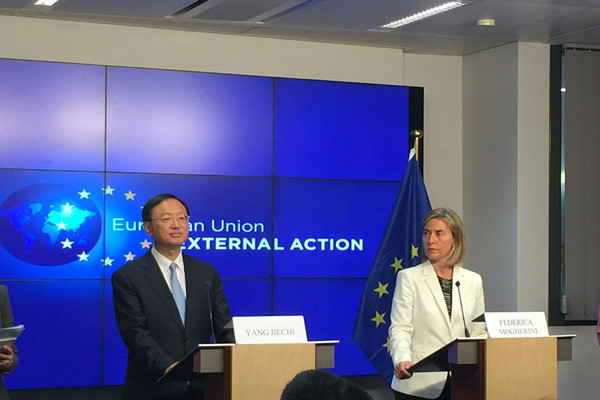
State Councilor Yang Jiechi and his EU counterpart Federica Mogherini vow to deepen the bilateral relationship at press conference of the sixth round of high-level strategic dialogue held in Brussels on Friday. [Photo by Fu Jing/chinadaily.com.cn] |
Editor's Note: Hainan-based China Institute for Reform and Development, one of the country's top think tanks, recently published a study that says the establishment of a China-EU Free Trade Area by 2020 will prove decisive in deepening Beijing-Brussels cooperation. Following is a summary of the report:
The period from now to 2020 is ideal for setting up a China-EU FTA, and the strategic options chosen by the two sides will determine the depth of cooperation between them.
Brexit has not only added more uncertainties to the European Union integration project, but also heightened the need to expedite the process of establishing a China-EU FTA as soon as possible.
Trade in services has become a major engine of global trade liberalization, a vital factor for upgrading global trade rules and an important reason for reforming global economic governance.
In 2014, the global trade in services (excluding government procurement of services) reached $9.8 trillion, an almost six-fold increase over 2000. This trend also saw the historic convergence of China's economic transformation in the context of global trade liberalization. Conservatively estimated, China's service trade is expected to exceed 50 trillion yuan ($7.49 trillion) by 2020, accounting for about 58 percent of its GDP, which can support medium growth for the next decade.
For the EU, despite the challenges it faces in economic recovery, the acceleration of global service trade has created new opportunities.
The next five years will see China engaged in the process of forming a large service market, while the EU will be developing long-term growth engines. The structure of China's household consumption has been changing, with the proportion of its urban residents' spending on services expected to reach 50 percent by 2020, and more than 60 percent in some better developed areas. This will make China and the EU more complementary in terms of economic development.
Therefore, starting the process to set up a China-EU FTA with service trade as priority will expedite China's economic transformation, as well as boost the EU's economic growth and employment.
A China-EU FTA could be set up in three steps by 2020: signing of a framework agreement, completing negotiations on key issues, and officially establishing the FTA.
Negotiations on only a "Comprehensive Agreement on Investment" have proved very difficult. The differences between the two sides are directly related to the opening-up of the service sector, which can be best resolved under a FTA framework.
In view of the global trend of incorporating investment treaty dialogue into trade agreement negotiations, we suggest the China-EU CAI dialogue be made part of the FTA negotiations by prioritizing the access to the service trade and market.
Solving structural problems by deepening structural reforms is a common choice for China and the EU and an important condition for establishing a China-EU FTA.
The EU has the major tasks of deepening its labor market reform, relaxing control on high-tech exports to China, markedly reducing technical barriers to trade, and removing the hurdles that restrict the movement of people involved in labor service cooperation.
China, on its part, should expedite the opening-up of its service market, raise the proportion of trade in services, deepen State-owned enterprises reform, increase the share of government purchase in public services in its total spending, and intensify government reform that prioritizes market regulation transformation.
In view of the new trend of globalization, of the overall China-EU relations, and of the trends and requirements of China's and the EU's respective transformation and growth, Beijing and Brussels should seize the opportunity to set up a China-EU FTA and advance it expeditiously.
Moreover, the two sides should further open up their markets with trade in services as the focus, deepen structural reforms, prioritize economic and trade cooperation to boost comprehensive cooperation in social, cultural and governance areas, and work together to push forward global trade liberalization.



Copyright 1995 - . All rights reserved. The content (including but not limited to text, photo, multimedia information, etc) published in this site belongs to China Daily Information Co (CDIC). Without written authorization from CDIC, such content shall not be republished or used in any form. Note: Browsers with 1024*768 or higher resolution are suggested for this site.
License for publishing multimedia online 0108263 Registration Number: 130349