 |
|
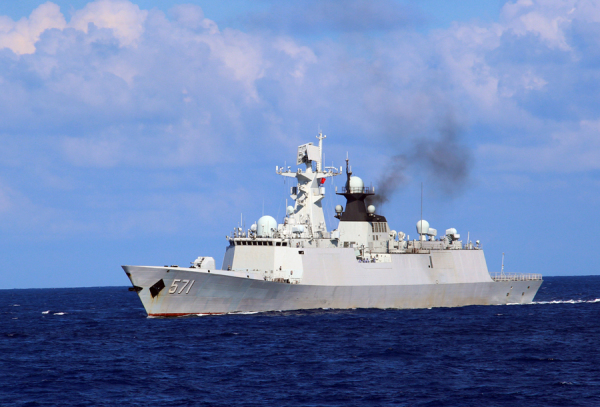
Missile destroyer Guangzhou launches an air-defense missile during a military exercise in the water area near south China's Hainan Island and Xisha islands, July 8, 2016. Chinese navy conducted an annual combat drill in the water area near south China's Hainan Island and Xisha islands on Friday. [Photo/Xinhua] |
The Arbitral Tribunal in the South China Sea arbitration will pass its ruling on July 12 on a case filed by the Philippines against China over a dispute in the South China Sea. Anticipating an unfavorable ruling, China's Foreign Ministry spokesman Hong Lei reiterated on Friday that Beijing will not accept it no matter how much diplomatic pressure is put on it.
The ruling is likely to have a variety of diplomatic implications for Asia-Pacific affairs. The United States, Japan and some ASEAN member states that have maritime disputes with China would like it to accept the ruling, which they believe is the most convenient way of encroaching upon China's sovereignty and maritime interests in the South China Sea.
Beijing has to stay alert to such dangers, for they could deal a major blow to its legal status in the South China Sea, be it in reclamation work or territorial claims. Beijing has to stick to its stance of not acknowledging or accepting, let alone implementing, the arbitral tribunal's ruling, simply because it will be illegal and thus null, and void.
But having made plenty of diplomatic, political and military efforts to hype up the arbitration during the past three years, the US will not sit idle while China tries to safeguard its lawful rights. Such are their differences on the South China Sea issue that many fear they could lead to a military conflict.
But China has no option but to defend its lawful rights. The South China Sea dispute between Beijing and Manila is essentially about territorial claims and maritime delimitation. Thanks to the US' abrupt intervention and the support of its allies, including Japan, Australia and some European countries, the Beijing-Manila dispute is being used as a bargaining chip in a strategic contest between the major powers in the Asia-Pacific region.
As President Xi Jinping declared in his speech on July 1 to mark the 95th anniversary of the founding of the Communist Party of China, Beijing will not use the threat of force nor will it flaunt its military power unnecessarily. This demonstrates not only China's determination to protect national interests but also serves as a warning to non-regional players such as the US.
Xi's remarks were echoed four days later by former State councilor Dai Bingguo, who said at a meeting in Washington that the tribunal's ruling would be "nothing but a piece of paper".
Once issued, the ruling will serve as a barometer of future China-US relations, but it is not likely to lead to a military conflict because it will not be good for either side and neither wants to escalate the already high tensions in the South China Sea.
Beijing should not only keep a close eye on countries that put military pressure on it to accept the arbitral tribunal's ruling, but also take measures to challenge the tribunal because it has exceeded and abused its powers by dealing with a case it has no jurisdiction over.
China and the US, on their parts, should exercise restraint and seek ways to reach a compromise on the South China Sea issue, because it does not define their bilateral ties. In particular, Washington should not overreact or overstate what the ruling stands for. More importantly, the fact that newly elected Philippine President Rodrigo Duterte has hinted that Beijing and Manila deserve better ties could be a silver lining in bilateral exchanges irrespective of the outcome of the tribunal's ruling.
The author is a professor and executive director of the China Center for Collaborative Studies of the South China Sea at Nanjing University.



Copyright 1995 - . All rights reserved. The content (including but not limited to text, photo, multimedia information, etc) published in this site belongs to China Daily Information Co (CDIC). Without written authorization from CDIC, such content shall not be republished or used in any form. Note: Browsers with 1024*768 or higher resolution are suggested for this site.
License for publishing multimedia online 0108263 Registration Number: 130349