Over the last three decades, State-owned enterprises underpinned China's emergence as a global manufacturing powerhouse, by spearheading the infrastructure construction boom. In the process, they became dominant, especially in sectors such as telecommunications and power and key strategic areas like steel, coal and banking.
But the traditional single-sided markets where SOEs lead are now being disrupted by new technology companies like Alibaba and Tencent, which straddle multi-sided markets of production, logistics and distribution by using unified platforms that benefit from economies of scale. By creating platforms for consumers and small-scale producers-what is essentially public infrastructure-these companies have directly challenged the SOE business model.
New digital platforms respond quickly and efficiently to public needs. These businesses are more collaborative or sharing than the traditional business of manufacturing, allowing consumers and smaller start-ups to shape products and services, from design to distribution. Given China's population of 1.3 billion-a major competitive advantage in terms of innovation and purchasing power-these platforms can disrupt the incumbent one-sided market producers by offering superior scale, speed and convenience, including access to global markets.
Besides, the SOEs' obsolete business model-not to mention strong inertia-makes it difficult for them to identify and respond to new opportunities in providing public goods in a changing economy. The State-owned telecom companies and banks, for example, have failed to respond to new technological challenges. Even traditional private companies like Huawei and Midea have done much better, adjusting to shifting consumer demand and changing factor costs by retooling as quickly as possible, acquiring, for example, robot technology and product designs from the West.
Such responsiveness is particularly critical today, when the inexorable logic of technological progress is demanding a transformation of China's growth model. With demand for consumer hardware and durables falling, China must begin to develop its own higher-tech products, while building a strong services sector. And with global goods exports declining-both cyclically and as a result of the growth slowdown in the advanced economies-China must activate its domestic consumer base.
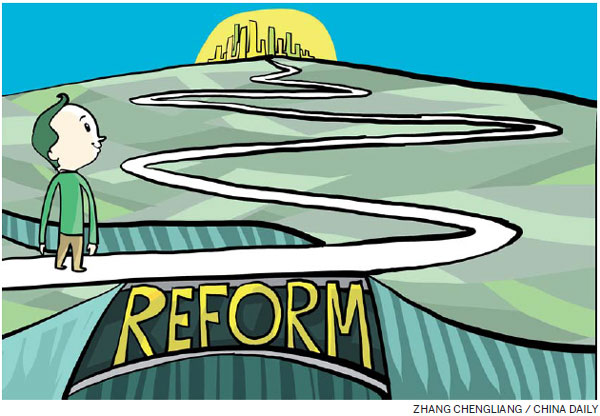
It is this uncertainty that seems to have prompted the authorities to rethink their original, more aggressive reform plan. They recognize that, when economic and financial systems comprise intricate networks of a variety of interlocking and interdependent elements, changes to one component-especially one as dominant as the SOE sector-can have far-reaching consequences. With the recent adjustments to the reform strategy, China's leaders have bought themselves some time to figure out where the SOEs can fit into the new economy.



Copyright 1995 - . All rights reserved. The content (including but not limited to text, photo, multimedia information, etc) published in this site belongs to China Daily Information Co (CDIC). Without written authorization from CDIC, such content shall not be republished or used in any form. Note: Browsers with 1024*768 or higher resolution are suggested for this site.
License for publishing multimedia online 0108263 Registration Number: 130349