 |
|
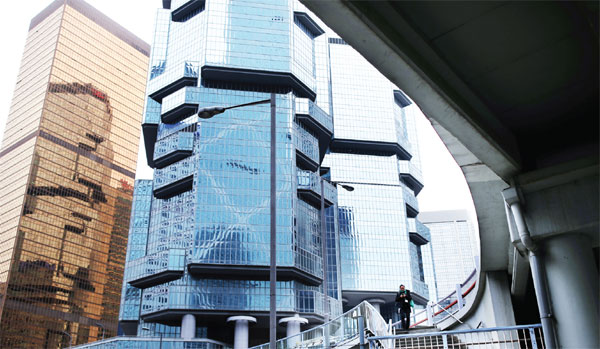
A view of Hong Kong's Central business district. Edmond Tang / China Daily |
Hong Kong faces great economic uncertainty and unprecedented market volatility, and given the Brexit chills, analysts expect a contraction. In fact, John Tsang Chun-wah, the Hong Kong Special Administration Region's financial secretary, has warned that the city's economy faces its "worst time in 20 years". Growth has more than halved to about 2.5 percent over the past five years.
The writing has been on the wall for Hong Kong since the outbreak of the global financial crisis, yet critical decisions have been delayed. The SAR's old growth drivers are still necessary but not enough to propel growth, because the West can no longer absorb Asian imports, and the Chinese mainland's economic growth has slowed down.
Last spring, concerns about Hong Kong's economy led some rating agencies to downgrade their outlook to negative, after doing the same for the mainland. But while the mainland can still rely on catch-up growth, Hong Kong's aging economy has to adjust to stagnating growth and income polarization.
In the past, Hong Kong's property developers reduced risks by relying on prudent financial policies, funding flexibility and recurring income streams. Today, those positives have been offset by rising supply, slower growth, and the United States Federal Reserve's future rate hikes.
True, retail sales can still contribute to Hong Kong's growth, but they cannot do so without mainland residents' critical role as consumption engines. Also, the SAR's thriving tourism sector is not viable without mainland residents, who comprise by far the largest group of tourists to Hong Kong. Actually, without the mainland, Hong Kong would be left with only half its trade and a quarter of its foreign investment.
Hong Kong is highly vulnerable to Brexit spillovers, too. Outside the European Union, it has perhaps the largest trade, investment and financial linkages with the United Kingdom. And because the value of Hong Kong dollar is rising on the back of the US dollar as investors seek safe havens, Hong Kong faces even greater headwinds than Singapore.
Last year, Hong Kong's exports to the UK and the rest of the EU comprised 14 percent of the total, relatively the highest in Asia and thus exposed to Brexit and EU risks. In contrast, the mainland's Belt and Road Initiative will allow Hong Kong to continue to benefit from trade and investment.
In the past, Hong Kong was the mainland's financial gateway to the world. But that role has been gradually taken over by Shanghai and other mainland cities, which makes Hong Kong's attractiveness as a financial hub non-viable without regional economic integration.
In the coming years, the current trends will become more prominent. During Hong Kong's reunification with the motherland in 1997, the US economy was almost 10 times bigger than China's. Europe was still integrating into a regional block. And Hong Kong's living standards were 11 times higher than those on the mainland.
Today-almost two decades later-the US economy is only about 40 percent larger than that of China. Europe faces fragmentation threats. Hong Kong's living standards are on average about 3.7 times higher than those on the mainland, but almost at par in certain districts of Shenzhen in Guangdong province.
Moreover, income polarization in Hong Kong has soared to alarming levels, according to the Gini coefficient, which some say is worse than those in Brazil or Zimbabwe in international comparisons.
Worried over the gloomy prospects, Hong Kong tycoon Li Ka-shing recently suggested raising profit tax to boost public spending and narrow the wealth gap. In the absence of hope, the political despair even among a few may undermine the living standards of many in the future.
But Hong Kong has a choice. By participating in the mainland's economic growth it can alleviate transitional pains and move to greater equity. To thrive, small and open economies need growth, integration-and hope.
The author is the founder of Difference Group and has served as research director at the India, China and America Institute (USA) and visiting fellow at the Shanghai Institutes for International Studies (China) and the EU Centre (Singapore).



Copyright 1995 - . All rights reserved. The content (including but not limited to text, photo, multimedia information, etc) published in this site belongs to China Daily Information Co (CDIC). Without written authorization from CDIC, such content shall not be republished or used in any form. Note: Browsers with 1024*768 or higher resolution are suggested for this site.
License for publishing multimedia online 0108263 Registration Number: 130349