 |
|
Luo Jie / China Daily |
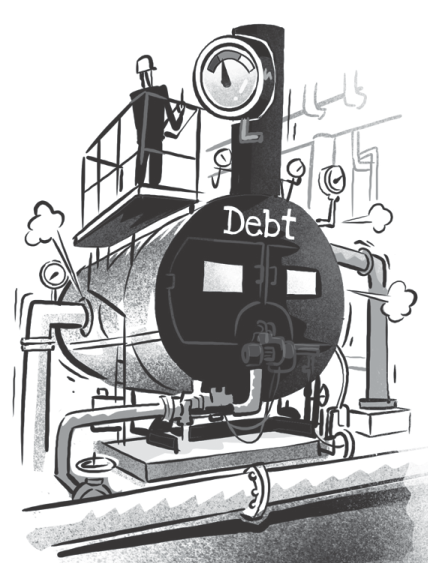
Recently, some experts have warned that China faces a financial/debt crisis worse than the 2008 US subprime crisis. But a closer look at the China's debt dynamics shows some fundamental differences between China's debt situation now and that of the US in the days leading to the 2008 global financial crisis.
The debt trends and problems in China may be worrisome, especially in the corporate sector, and the credit expansion is indeed fast. But that doesn't mean China is moving toward a financial/debt crisis.
It is true China's debt to GDP ratio is high at about 225 percent of GDP-the ratio is lower than some developed countries but higher than almost all developing countries. But the structure of Chinese liabilities appears to be safe. Debt denominated in foreign currencies is about 12 percent of GDP, dwarfed by China's foreign exchange reserves as well as assets held abroad. China also has a relatively big current account surplus. Therefore, the currency mismatch in debt position is not a problem for the country.
The Chinese government's debt is about 40 percent of GDP, a manageable ratio and lower than that of many advanced economies. The central government debt may not be, but local government debt is huge. The Achilles heel is corporate debt of 145 percent of GDP, a dangerous level. But most of the corporate debt is either bank loans or domestic onshore, instead of offshore, bonds. And although household debt is about 40 percent of GDP, much of it is concentrated in house mortgages that are considered high-quality collaterals with low probability of defaulting.
Household savings, on the other hand, are high-their total liquid assets in the banking system being about 80 percent of GDP in 2015. This is an important cushion. It seems there is healthy risk sharing across households and enterprises, meaning households save and enterprises borrow.
Another mitigating factor is that much of the credit has been coming from banks. China's financial system still lacks the sophistication, securitization for example, of the advanced economies. But this is a blessing in disguise, because debt instruments are not highly leveraged. Still, non-performing loans and shadow banking remain nagging problems.
China's GDP growth rate is decent-6.9 percent-especially given the global economic environment, and its growth outlook is still robust. This is important, for a healthy economic growth is essential for debt reduction and sustainability.
The most dangerous trend is the speed of debt accumulation, which could become a systemic risk if not addressed quickly. Nevertheless, certain features of the Chinese economy allow corrective measures to be taken more quickly than some other economies. For instance, capital control measures and State ownership of some important banks can provide the government with more policy space in times of need. A comforting fact is that high leverage is not a problem that the government is unaware of.
Given China's asset and liability position, a debt crisis is unlikely in the short term barring seismic global financial volatility. Even in the worst-case scenario of all corporate and local government debts turning into non-performing loans, which is highly likely, the Chinese government will still have tools and resources to deal with the problem.
On the whole, China has very significant amounts of highly liquid assets, and it appears the government is aware of the magnitude of the debt problem and has already taken measures to address it. But to overcome the challenges posed by the debt problem and maintain debt sustainability, it would be important to take quick and decisive measures including:
Slowing down the fast credit expansion and enhancing investment quality;
Undertaking structural reform of State-owned enterprises and taxation reform for local governments;
Maintaining economic growth;
Strengthening deposit insurance; and
Continuing with the current deleveraging policy measures for local governments and enterprises.
The author is special adviser on Economics and Development Finance to the South Center in Geneva.



I’ve lived in China for quite a considerable time including my graduate school years, travelled and worked in a few cities and still choose my destination taking into consideration the density of smog or PM2.5 particulate matter in the region.
Copyright 1995 - . All rights reserved. The content (including but not limited to text, photo, multimedia information, etc) published in this site belongs to China Daily Information Co (CDIC). Without written authorization from CDIC, such content shall not be republished or used in any form. Note: Browsers with 1024*768 or higher resolution are suggested for this site.
License for publishing multimedia online 0108263 Registration Number: 130349