 |
|
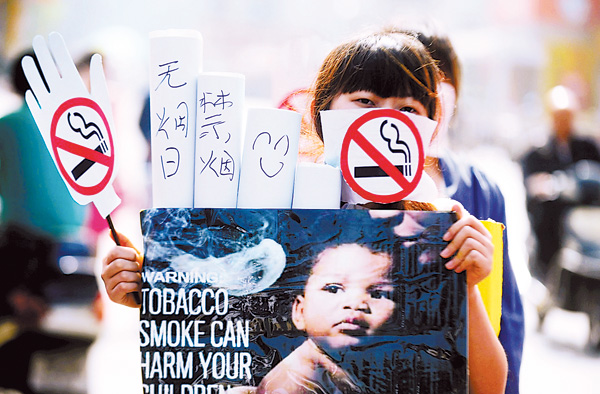
A student from Yangzhou University demonstrates against smoking during a street campaign in Yangzhou, Jiangsu province, in December, 2015. [Photo by Meng Delong / For China Daily] |
Eighteen months ago, I was thrilled when-in the same week-Beijing adopted a law to make all indoor public places in the city 100 percent smoke-free; and the State Council, China's cabinet, published draft national regulations to enact a ban on smoking in public places across the country. Finally, I thought then, China is getting serious about addressing a problem which kills two Chinese people every minute, and in doing so, takes an enormous toll on China's health system and economy.
On World No Tobacco day, one year after the excellent Beijing smoke-free law came into effect, there is much to celebrate: enforcement of the Beijing law has been strong, compliance rates good, public support extremely high, and Beijingers breathing easier as a result. Beijing has shown it can be done.
However, I am sad to say progress on the national law has not been so positive. In fact, I am bitterly disappointed. A range of very problematic loopholes in the draft law have appeared: smoking would be permitted in individual offices, as well as other public places like restaurants, bars, hotels, and airports. Not even hospital campuses would be entirely smoke-free.
Including these exemptions in the national smoke-free law is a very bad idea, for several reasons. First, they would be utterly contrary to the WHO Framework Convention on Tobacco Control (WHO FCTC), which China's National People's Congress, the top legislature ratified in 2005. The treaty is crystal clear that preventing exposure to carcinogenic second-hand smoke requires a 100 percent smoke-free environment. There is no safe level of exposure, so there can be no exceptions. Anything less than 100 percent smoke-free simply will not work: thus, the current draft regulations will be about as useful for protecting health as a bucket with a giant hole in the bottom is for collecting water.
Second, a weak national smoke-free law would be inconsistent with the 2013 joint Communist Party-State Council Notice (the joint policy by the General Office of the Communist Party of China's Central Committee and the General Office of the State Council on promoting smoke-free public places, issued in December 2013), which urged government officials to take the lead in promoting smoke-free public places. Exempting leaders' offices from the smoking ban would seem to create a culture of privileges-while putting the health of others at risk.
Sadly, it is clear that the vested interests of the tobacco industry have been able to corrupt the national law discussions with a series of superficially compelling yet completely false arguments-many of which we have heard before, around the world.
For instance, the industry is arguing that a strong tobacco control law would hurt the economy. This is completely untrue. This law is about protecting the vast majority of Chinese people-who are non-smokers-against the terrible harms of second-hand smoke. International evidence shows that effective smoke-free laws are an economic plus: they reduce the enormous costs of tobacco use and second-hand smoke for individuals, businesses and society.
The industry is also arguing that enforcement will be difficult across China, so a lesser smoke-free law will be easier to enforce. Again, completely untrue. A smoke-free law full of loopholes will be more difficult to implement, as experience the world over has shown. China's neighbour, Russia, has had very good experience in enforcing its strong smoke-free law. The easiest law to enforce is one that is simple, and that everyone understands.
There are 1 million reasons not to accept the tobacco industry's arguments: that's the number of people who are killed by their products in China every year. It would be a travesty if vested industry interests are allowed to wreck the possibility of a law designed to protect health.
The exemptions that have appeared in the draft law, which are against the legally binding WHO FCTC, must be removed. If the law is adopted in its current form, I fear it would do great damage to China's international standing, just when Shanghai is preparing to host a major international conference on health promotion later this year.
Yet, a strong national smoke-free law would be one of the greatest steps forward for public health in China that we have ever seen. And it would place China among the world's leaders in standing up for the health of its people. Healthy China needs a strong, 100 percent smoke-free national law.
The author is the WHO's Representative in China.



I’ve lived in China for quite a considerable time including my graduate school years, travelled and worked in a few cities and still choose my destination taking into consideration the density of smog or PM2.5 particulate matter in the region.
Copyright 1995 - . All rights reserved. The content (including but not limited to text, photo, multimedia information, etc) published in this site belongs to China Daily Information Co (CDIC). Without written authorization from CDIC, such content shall not be republished or used in any form. Note: Browsers with 1024*768 or higher resolution are suggested for this site.
License for publishing multimedia online 0108263 Registration Number: 130349