 |
|
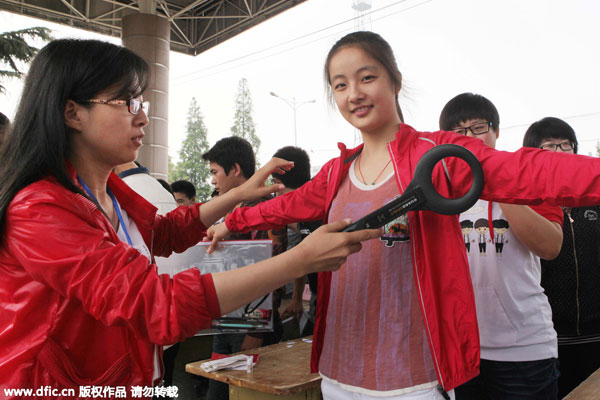
A student goes through a metal detector in Lianyungang, Jiangsu province. [Photo/IC] |
As this year's gaokao, or national college entrance examination, approaches, the adjustments to the college enrollment policy in some regions have caused public concern.
With some developed provinces and municipalities offering some of their existing quota of college places to students from the less-developed central and western regions, parents and students fear they will lose out as a result of the adjustments, and complain that it's unfair for their children to give way to students whose scores in the exam might be lower.
Despite the education authorities' repeated promises that the original local recruitment quotas will not shrink, there have been growing calls in some populous provinces for unified exam papers and college recruitment policies nationwide, meaning all colleges should enroll students according to the same admission score no matter where the candidates are from. Currently different regions at the provincial level set their own exam papers and college recruitment quotas.
Striving for fairness is reasonable and necessary in any society, but the question is how to achieve that goal in real life. This "absolutely fair" method believes exam scores can guarantee fairness and help select the best students under a unified standard, but it ignores the students' different situations and fails to realize the negative effects it may have.
The strong resistance of students and parents to any adjustments in college enrollment policies is understandable as they may impact an individual's entire life. In any society education is the most accessible channel to achieve social mobility. And even though a college degree cannot guarantee a brilliant future as it used to, a higher education is still a necessity in the pursuit of "a better life" for most people in China. Especially for poorer families, it may be the only way children can change their fate.
With the gap between the rich and the poor in the country growing ever wider, educational fairness is a highly sensitive issue.
Compared with students from rich families and the more developed regions, students from poor families and the less developed regions are in a disadvantaged position in front of the same examination paper. If all the colleges admit students according to the same admission score, it is imaginable that they will enroll more students from well-off families and the developed regions, as these families can afford to pay more for their children's education. In addition, if the admission score becomes the only criterion for college enrollment, basic education will be more exam-oriented, and the best educational resources will be further concentrated in the developed regions. This would not only reduce the chance for students from undeveloped regions and poor families to have higher education, but would also undermine the cultivation of the country's best talents.
As college enrollment is a competition for limited educational resources, there seems no win-win result that can satisfy everyone.
But the real question is: What do we really talk about when we talk about fairness?
And the answer to that is we're talking about interests.
China's college enrollment dilemma is the same as the hukou (household registration) problem. Because of limited resources and the actual situations in different areas, people in an inferior position have less access to resources, and those in more advantageous positions are reluctant to give them more access, fearing they will lose some of the advantages they enjoy.
Instead of debating the "legitimacy" of this situation, people should realize that limited and unbalanced educational resources among different regions are the root of the problem.
To promote relative fairness, the education authorities are providing favorable college enrollment policies to candidates from the central and western regions. But this should only be a short-term measure, in the long run, what is needed is more educational resources for the less developed regions, as this is what will really benefit students there.
The author is a writer with China Daily. wangyiqing@chinadaily.com.cn



Copyright 1995 - . All rights reserved. The content (including but not limited to text, photo, multimedia information, etc) published in this site belongs to China Daily Information Co (CDIC). Without written authorization from CDIC, such content shall not be republished or used in any form. Note: Browsers with 1024*768 or higher resolution are suggested for this site.
License for publishing multimedia online 0108263 Registration Number: 130349