 |
|
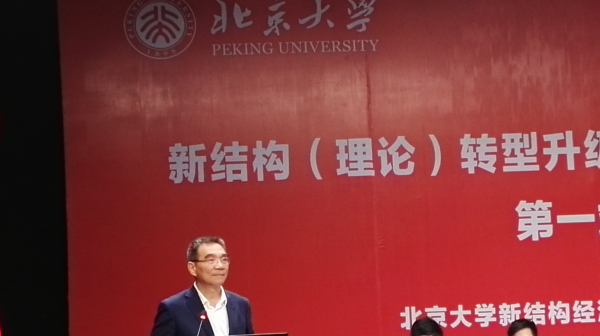
Justin Yifu Lin's giving speech during the launch ceremony of the report. [Photo by Wuzheyu / chinadaily.com.cn] |
The Center for New Structural Economics of Peking University recently reported on a trial six-month investigation and survey in Hejian, a county-level city in north China’s Hebei province. This is the center’s first case study on enterprises’ transformation and upgrading through cooperation with local governments applying new structural economic theory.
The center’s motivation and effort behind this detailed and comprehensive empirical research may be sourced to their original mission, as described by Justin Yifu Lin, the center’s director in a speech at a symposium on new structural economics: apply new structural economic theory in practice, help developing counties and local authorities to formulate concrete policies, and keep exploring the key factors that determine the evolution of economic structure. And determine the roles of government, enterprises and the market against this background. If the academic theories prove inapplicable to the real world, they can function as no more than logic games. The Center for New Structural Economics is building a practice platform to bridge the gap between theories and real life.
The whole report is based on empirical research describing and analyzing local enterprises’ operating situations in several main industries of Hejian, for the sake of helping local authority formulate better policy design. The industries include automotive components manufacturing and re-manufacturing, information technology, and craft glass manufacturing.
The analytical framework used to process the data focuses on four aspects of sample companies: entrepreneurship and operations, resource endowment (material resources including funds, land and plants, and also human capital), value chain (procurement, production and quality monitoring), transformation and upgrading (pressure and desire to change, metrics and prospects).
Several preliminary conclusions were made after information from the studied companies was gathered both quantitatively and qualitatively. The study group predicts that Hejian city could achieve 8.5% annualized GDP growth rate until 2020, and fulfill their goal of industrial upgrading in modern service, agriculture and manufacturing with a potential economic growth rate of 17%; quite an impressive result considering the current global economic downturn. Given the fact that only a few local enterprises use financial tools like trading on equity or capital increase and share expansion, the local government is advised to strengthen education, offer preferential loans, and help enterprises to get bank loans or refinancing. All the efforts are aimed at improving local private investment and then attracting more business to local markets.
An interesting phenomenon which seems quite rare comparing to other areas’ normal situation is that almost all the enterprises participating in the survey have strong confidence in their prospects. Their confidence rests on the region’s perceived economic development potential. Individual entrepreneurs’ self-confidence tends to exceed their expectations of their industry in general.
Doctor Fu Caihui, the reporter of this survey, warned that local enterprises’ over-confidence in their own manufacturing technique which is easy to be copied but hard to imitate from others, maybe a problem in their further development, according to their research and investigation.
The analysis shows challenges and opportunities of enterprises in Hejian city, which might be a microcosmic reflection of China’s economy. This case study may add light to further research on general county territory economies.
Justin Yifu Lin, in commenting on the report during the launching ceremony, pointed out that only joint efforts of efficient markets and effective government can accomplish an optimal distribution of resources. Technological innovation, industry upgrading and competitive mechanisms are effective and required to facilitate the local market and narrow the gap between developed regions, or attract international talent and capital.
New structural economics is an outstanding theory that systematically summarizes successful and failed practical experience of developing countries without copying theories from developed countries, said Justin Yifu Lin. He recalled his participation in a recent symposium on philosophy and social sciences, where President Xi encouraged participants to integrate socialist theory with Chinese characteristics into their research. Lin emphasized that new structural economics is a theory well-equipped to advance China’s performance.



I’ve lived in China for quite a considerable time including my graduate school years, travelled and worked in a few cities and still choose my destination taking into consideration the density of smog or PM2.5 particulate matter in the region.
Copyright 1995 - . All rights reserved. The content (including but not limited to text, photo, multimedia information, etc) published in this site belongs to China Daily Information Co (CDIC). Without written authorization from CDIC, such content shall not be republished or used in any form. Note: Browsers with 1024*768 or higher resolution are suggested for this site.
License for publishing multimedia online 0108263 Registration Number: 130349