 |
|
SONG CHEN/CHINA DAILY |
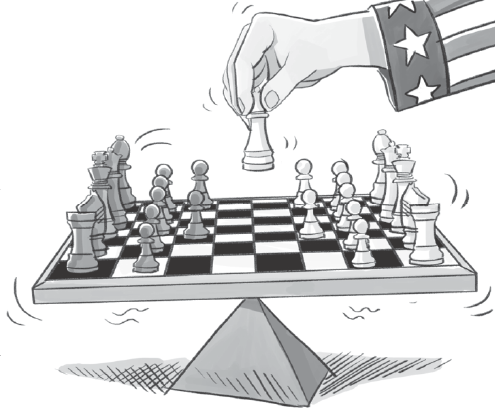
US President Barack Obama has merely half a year to go before leaving office, and to consolidate his administration's strategy of rebalancing to the Asia-Pacific before leaving office, he is visiting Vietnam and will attend the G7 Summit in Japan.
Obama will be the third US president to visit Vietnam since the Vietnam War ended in 1975. While it is commendable that these two former foes turn their animosity to friendship, Washington is inspired by its geostrategic intent and wants Vietnam to be part of its rebalancing strategy.
At present, the US is deeply upset by China's rapid rise. To sustain its regional leadership, it has not only dispatched its bombers and destroyers to challenge China, it has also been strengthening its alliances and partnerships. Vietnam is seen as being useful to the US' strategic plan, and Obama may announce the lifting of the decades' long arms embargo that the US has imposed against this former adversary.
Although the US feels that China's growing military strength warrants its meddling, the facts clearly establish who has changed the previous regional balance. It was Japan that sparked the flare-up in the territorial disputes due to its "nationalization" of the Diaoyu Islands in 2012.
The US should reflect on who are the revisionists, in terms of both history and territory, and which country is upsetting the status quo.
And while it is true China has reclaimed land in South China Sea. It was Vietnam that started such activities. Hanoi has been doing such reclamation work for decades and is still doing so. Some of this reclamation work has been in the Xisha Islands which it has acknowledged belong to China. Therefore, blaming China for the deteriorating situation in the East and South China seas is hardly fair. The US argues that China is carrying out its reclamation work too fast and on too large a scale. But if China proceeded more slowly and on a smaller scale impressively, would the US change its attitude? No, it would still point an accusing finger at China.
Tokyo and Hanoi welcome Washington being a counterbalance to China, but they should be aware that the US is using them as tools for its own purpose.
Vietnam should be mindful of its ideological gulf with the US, and realize that buying a few weapons from the US is hardly going to make it more competitive with China. Since Vietnam and China have proven that they are able to resolve their differences, as shown by the Beibu Gulf Demarcation Agreement, they should continue to negotiate and make mutual concessions to find solutions to their outstanding disputes.
US leadership in the region can be respected so long as it is unbiased. But to impose an order with partiality is unsustainable. President Obama's rebalancing strategy has not attained much during his tenure. With his departure, the strategy might be adjusted or dropped. With the renewed efforts to draw up a Code of Conduct for the South China Sea, various stakeholders in the region are developing a greater sense of collective identity as well as common security. As this makes further progress, the US' rebalancing will lose its market.
The author is professor and associate dean at Institute of International Studies, Fudan University.



I’ve lived in China for quite a considerable time including my graduate school years, travelled and worked in a few cities and still choose my destination taking into consideration the density of smog or PM2.5 particulate matter in the region.
Copyright 1995 - . All rights reserved. The content (including but not limited to text, photo, multimedia information, etc) published in this site belongs to China Daily Information Co (CDIC). Without written authorization from CDIC, such content shall not be republished or used in any form. Note: Browsers with 1024*768 or higher resolution are suggested for this site.
License for publishing multimedia online 0108263 Registration Number: 130349