 |
|
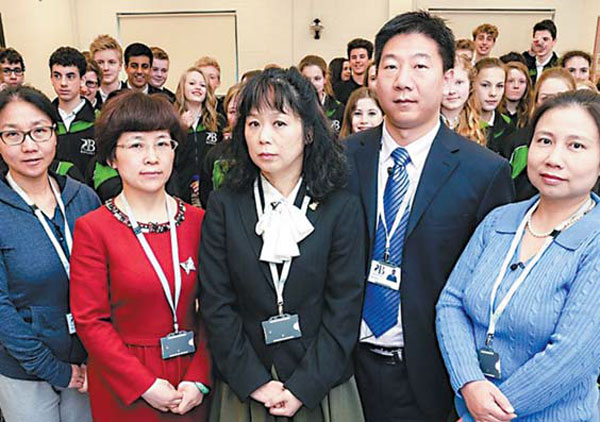
The five Chinese teachers featured in the BBC documentary Are Our Kids Tough Enough? Chinese School. The documentary triggered a heated debate on British and Chinese education methods. |
Education has traditionally been seen as a way out of poverty, and nowhere is this truer than in China. In Shanghai, particularly, a modern education system has been evolving since the mid-19th century, and education reforms have been carried out in step with the city's growth into a global commercial and trading hub.
What is astounding about Shanghai, however, is not just that it leads education reform within China. With a per capita GDP just above high-income threshold, the city already leads the world in terms of international performance in mathematics, science, and reading among 15-year-olds, as measured by tests developed by the Organization for Economic Cooperation and Development.
The city is a perfect illustration of the broad global finding that the quality of education-that is, what workers learn while in school-matters for economic growth. Higher quality education is a prominent factor in the striking success of East Asia compared to other world regions. This correlation is now recognized within the new Sustainable Development Goals adopted at the United Nations in 2015. Among other targets, the goals call for access to quality education for all by 2030 and lifelong learning opportunities. This is a major step up from the previous global target of universal access to primary education.
Against this global backdrop, developing countries are trying to find ways to solve an incredibly difficult problem: how to make sure that students learn. This has to do with as many as 250 million children around the world being unable to read or write despite having been to school. For these children, education simply does not fulfill its traditional promise. There are also 124 million children out of school at the primary and lower secondary levels.
Unsurprisingly, there is huge interest in the Shanghai education system. Representatives from over 25 countries are here in Shanghai this week to gain insights from the city's enormous success in both enrolling children-including from migrant families-as well as paying attention to the quality of education in all schools. The question is, how does Shanghai do it?
While many tend to attribute educational success in China with the influence of Confucian culture, a recent evaluation of Shanghai's educational system, using international benchmarks developed by the World Bank, shows that success is in fact also the result of deliberate measures and reforms to raise student learning levels; and the city's constant drive for excellence, careful planning, and meticulous implementation of policies.
These policies include excellent management of public finances for education, clear and well aligned learning standards, curriculum, and assessment system; maintaining the reputation and efficacy of the teaching force; taking strong steps to bring disadvantaged children into the system; and pairing low-performing schools with high-performing ones to help raise performance.
Shanghai continues to plan for a stronger education system that will meet the needs of a creative 21st century economy, including developing socio-emotional skills alongside cognitive ones. In other words, the city recognizes its own areas of improvement and persists with reform. For many developing countries, however, the city's education system remains an ideal, and lessons from Shanghai are exceptionally useful as they come, in the final analysis, from the heart of a developing nation that has made incredible inroads against poverty in recent decades.
At the World Bank we work with China and other countries to make education systems stronger at all levels from preschool to higher education, so that they can provide students with the skills necessary to promote shared prosperity, productivity and economic growth. It is part of our role to promote global exchange of knowledge, so that the path to the Sustainable Development Goals is better lit.
Bert Hofman is World Bank country director for China, Mongolia and South Korea, and Harry Patrinos is World Bank Practice Manager, Education, for East Asia and the Pacific.



I’ve lived in China for quite a considerable time including my graduate school years, travelled and worked in a few cities and still choose my destination taking into consideration the density of smog or PM2.5 particulate matter in the region.
Copyright 1995 - . All rights reserved. The content (including but not limited to text, photo, multimedia information, etc) published in this site belongs to China Daily Information Co (CDIC). Without written authorization from CDIC, such content shall not be republished or used in any form. Note: Browsers with 1024*768 or higher resolution are suggested for this site.
License for publishing multimedia online 0108263 Registration Number: 130349