 |
|
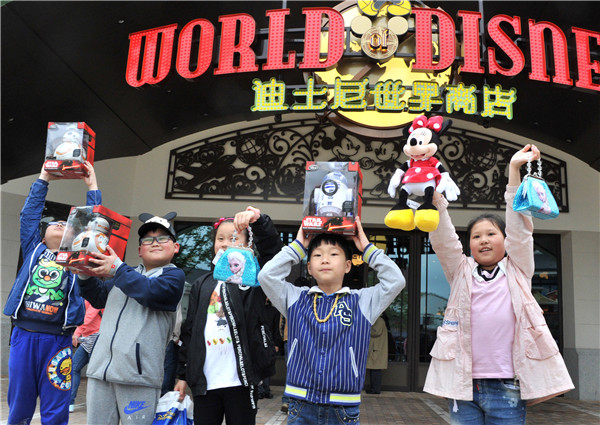
Children show off souvenirs bought at the Disney store, the biggest park-operated retail shop in Asia, in Shanghai. Yang Yi / For China Daily |
Fans of the world-famous theme park started scrambling for opening-day admission long before the scheduled opening of the Disney Resort in Shanghai on June 16.
The project is the largest of all cultural exchange programs signed between China and the United States, and it will not only have far-reaching influences on the global theme park market and the development of China's cultural and leisure industries, but also on the hospitality industry, cultural creation industry and other service industries in the Yangtze River Delta.
The Walt Disney Company had long had its eyes on the Yangtze River Delta, the most developed, most densely populated and most market-radiant area in China. The opening of the new site helps consolidate Disney's position as one of the world's top three theme-park companies, and the operation in China is even likely to significantly avert the decline of the multinational's global business.
In fact, China's theme park industry has been bucking the trend of worldwide sluggish spending since the outbreak of the global financial crisis in 2008. A "theme park fever" hit many cities across the country. In 2012 and 2013 alone, a total of 14 new theme parks opened. And more than 60 are under construction, which will make China home to the world's largest number of theme parks.
However, the picture is not all rosy for theme park companies in China as there have also been failures.
Undoubtedly, the opening of the Disney theme park in Shanghai is a creative move-and will prove to be a milestone-in Sino-American cultural exchanges. First, it provides a large, comprehensive entertainment platform for the Chinese public to get a taste of US culture. And that Chinese elements have been assimilated will no doubt impart to it a distinctive character as the two different cultures are combined. Second, it will change the structure of the Chinese market for theme parks, as it will lead to a redistribution of customers, which, in turn, will force theme park operators to upgrade their products in order to compete. Old-fashioned and unadventurous theme parks will lose visitors. Only those presenting rich and new experiences tailored to customers' tastes will survive. This is something that Disney has proved adept at providing.
And it is something that it will need to continue doing, as China's culture consumers, including theme park goers, are fast maturing. Many tourists from the Chinese mainland have already been to a Disneyland, whether in Hong Kong, Orlando, Tokyo or Paris. For them, the thrilling sensory experiences, moving stories and gorgeous costumes and scenes are no longer new.
It is surely not easy to find the best business model to sustain a money-spinning theme park. Such venues make up only 30 percent of the entire operations of the Walt Disney Company, with the remaining 70 percent distributed across movies and their derivatives, and the media, of which media networks account for 40 percent. That 70 percent, however, provides an inexhaustible source of innovation for the group's theme parks. Of the 30 percent that is generated by its theme parks, revenue from admission fees makes up only 30 percent, with the other 70 percent coming from visitors' spending in shops and restaurants inside the park.
Anyone in the entertainment industry will have to strive hard to create a unique experience for every customer if they want to succeed in the increasingly competitive Chinese market.
The author is a research fellow at Literature Institute of Shanghai Academy of Social Sciences and the deputy chief of the Shanghai Dongfang Public Culture Evaluation Center.
source: chinausfocus.com



I’ve lived in China for quite a considerable time including my graduate school years, travelled and worked in a few cities and still choose my destination taking into consideration the density of smog or PM2.5 particulate matter in the region.
Copyright 1995 - . All rights reserved. The content (including but not limited to text, photo, multimedia information, etc) published in this site belongs to China Daily Information Co (CDIC). Without written authorization from CDIC, such content shall not be republished or used in any form. Note: Browsers with 1024*768 or higher resolution are suggested for this site.
License for publishing multimedia online 0108263 Registration Number: 130349