 |
|
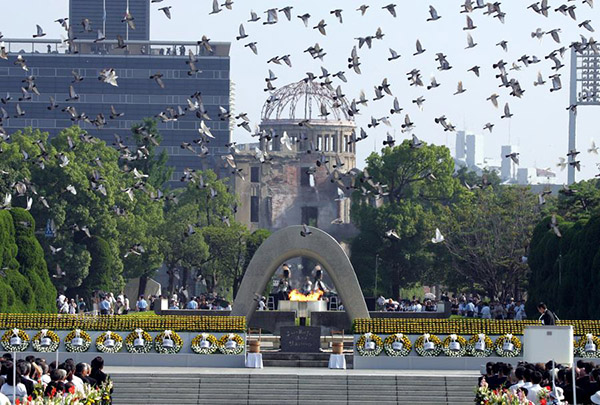
Doves fly over the Peace Memorial Park with a view of the gutted A-bomb dome at a ceremony in Hiroshima, Japan August 6, 2006. [Photo/Agencies] |
The White House announced on Tuesday that US President Barack Obama will visit Hiroshima later this month when he visits the country to attend the G7 Summit. It will be the first visit by a sitting US president. However, it would be wrong to interpret this as a message that the US is apologizing for the atomic bomb it dropped on Hiroshima in August 1945, which killed tens of thousands of Japanese.
Hiroshima was the target for the world's first use of a nuclear weapon. A US Army Air Force B-29 called the Enola Gay – the name of the flight commander's mother – dropped the Uranium-235 implosive device. Around 75,000 people were killed immediately and another estimated 125,000 died in the following years from the radiation and other injuries they sustained.
Three days later, the only other use of nuclear weapons against a human-inhabited target so far took place, when another US B-29 bomber carrying a more powerful plutonium device destroyed the Japanese city of Nagasaki.
US policymakers led by then president Harry S. Truman approved the attacks as a desperate measure to end World War II without having to launch Operation Olympic, the allied invasion of the home islands of Japan.
Sober US military assessments estimated that the invasion might cost hundreds of thousands Americans dead and millions more Japanese casualties.
The war that Truman wanted to end as rapidly as possible had already cost, by most recent estimates, 80 million lives including at least 27 million Russian dead, 16 million Chinese, overwhelmingly civilians, and the six million Jewish victims of the Nazi Holocaust.
But what is always forgotten across the United States and Europe is that the terrible war did not begin with the Nazi invasion of Poland in September 1939: it began with the Japanese invasion and effort to conquer China in 1937.
In the first nightmarish summer of war in 1937, the Japanese Imperial Army drove west up the Yangtze River Valley, slaughtering everyone in their path.
When they reached the Chinese capital of Nanjing, they carried out the first monstrous atrocity of the war, the Rape of Nanjing, killing at least 300,000 people and the mass rape of untold numbers of Chinese women. The atrocities were so terrible they even shocked card-carrying German members of the Nazi Party who witnessed them.
Ironically, the city of Hiroshima played a fateful role in these awful events. For the Imperial Japanese Army's military headquarters from which the drive up the Yangtze and the subjugation of Nanjing were directed was based in Hiroshima.
In the more than 70 years since those awful events, Hiroshima has become the symbol of the feared new nuclear age. It is, therefore, understandable that the Japanese media are stressing the issue of nuclear non-proliferation. That should be a priority issue at the G7 Summit. That is especially the case since it follows so rapidly after the conclusion of US President Barack Obama's latest Nuclear Security Summit in Washington, DC.
But as today's government in Tokyo supports the confrontational US maritime policies in the South China Sea, those attending the summit would also do well to recall the reckless, headlong charge into war of the militarist Japanese governments of the 1930s.
For the road to Hiroshima truly began with the atrocities of the drive up the Yangtze eight years earlier.
The author is a national columnist for the Post-Examiner online newspapers in the US and senior fellow of the American University in Moscow. He is the author of Cycles of Change: The Three Great Cycles of American History



I’ve lived in China for quite a considerable time including my graduate school years, travelled and worked in a few cities and still choose my destination taking into consideration the density of smog or PM2.5 particulate matter in the region.
Copyright 1995 - . All rights reserved. The content (including but not limited to text, photo, multimedia information, etc) published in this site belongs to China Daily Information Co (CDIC). Without written authorization from CDIC, such content shall not be republished or used in any form. Note: Browsers with 1024*768 or higher resolution are suggested for this site.
License for publishing multimedia online 0108263 Registration Number: 130349