China's top leader Xi Jinping recently reiterated the importance of media. Talking about how to promote the "Convergence of Traditional Media and New Media", Xi said media should pay attention to both convergence and management, and ensure media convergence advances in the right direction. Besides, Xi recently visited the offices of three mainstream media outlets, stressing the urgency and significance of embracing new media.
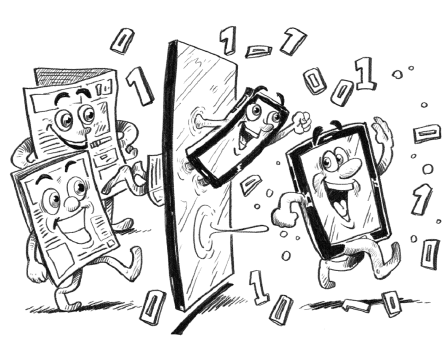
New media have expanded across China, with Jiemian and The Paper in Shanghai, Jiupai in Central China's Hubei province, and the Cover in Southwest China's Sichuan province. They have increased their share in the market, too. The first impact of new media on the traditional media is the loss of readers, resulting in falling circulation. Consequently, advertisers have turned to new media and it is becoming increasingly difficult for publishers to survive, let alone make profits.
Moreover, readers' habits have changed in this age of new media. The old way of storytelling no longer appeals to readers and viewers. The younger generation favors mobile devices and entertaining ways of storytelling, forcing the traditional media to focus on visualization and participative reporting. Information technology devices allow readers to access information without the limits of time and space, further reducing the attractiveness of the print media.
The relationship between journalists and readers, too, has changed. User-generated content has become a vital part of news production, and "citizen journalism" is today an accepted fact. Editors are not the only gatekeepers for media outlets. In the age of information explosion, it's the users that decide what and when to read.
The traditional media have no choice but to change in order to survive. And traditional publishers have to gradually shift to new media to avoid becoming history.
According to a China Internet Network Information Center report, issued in July 2015, the number of mobile phone users in the country is 620 million, which reflects the huge market for "mobile reading". Therefore, the traditional media should adopt creative mobile strategies to meet people's fast-changing appetite. One way of doing so is to customize the contents of mobile terminals.
As more and more traditional media outlets direct their attention to mobile apps, only uploading contents from the print editions on the internet will not be enough to draw readers and to shift to new media. Publishers should pay more attention to readers' experiences. For example, they have to find out what kinds of contents are suitable for mobile devices and what sort of presentation gives the best visual feeling. Publishers' "mobile-phone strategy" will, to a large extent, determine the success of their shift to new media.
Publishers should also use a combination of new methods to present news, because readers and viewers today demand more and varied information. They need to adopt methods like visualization and virtual reality to effectively present an event. And to shift to new media, publishers have to build a journalists' team that can make full use of new technologies and know how to combine them with objective journalism.
Therefore, journalists need to radically change the way they approach news, which essentially means the traditional media have to change the way they tell a story and train their journalists in new media skills.
More importantly, the traditional media ought to make more efforts to engage and interact with readers and viewers, who in turn can make greater contribution to the presentation of a story. And user-generated content is a source that editors should pay more attention to, because "citizen journalists" have been responsible for quite a few "breaking news". Interactions with readers and viewers are equally important as they can help editors focus more on what their target audiences want.
Tian Zhihui is professor of new media studies at the Communication University of China, Beijing. And Zhao Fan is MA student of Communication University of China.



I’ve lived in China for quite a considerable time including my graduate school years, travelled and worked in a few cities and still choose my destination taking into consideration the density of smog or PM2.5 particulate matter in the region.
Copyright 1995 - . All rights reserved. The content (including but not limited to text, photo, multimedia information, etc) published in this site belongs to China Daily Information Co (CDIC). Without written authorization from CDIC, such content shall not be republished or used in any form. Note: Browsers with 1024*768 or higher resolution are suggested for this site.
License for publishing multimedia online 0108263 Registration Number: 130349