 |
|
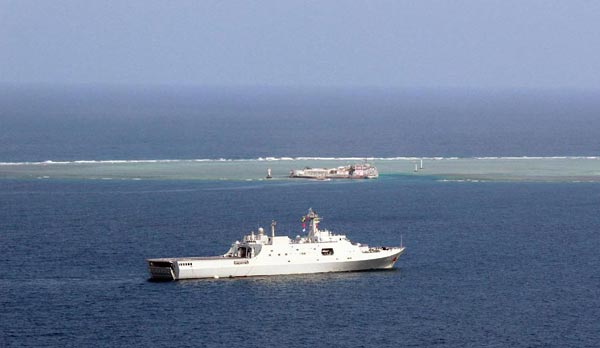
A formation of the Nanhai Fleet of China's Navy on Saturday finished a three-day patrol of the Nansha islands in the South China Sea. [Photo/Xinhua] |
On Oct 29, 2015, the Arbitral Tribunal constituted under Annex VII to the United Nations Convention on the Law of the Sea in the arbitration instituted by the Philippines against China rendered its award on jurisdiction and admissibility. The tribunal concluded that it does have jurisdiction over the matters raised in seven of the Philippines' claims.
On Oct 30, the Chinese Foreign Ministry issued a statement saying the award is null and void, and that it has no binding effect on China. Subsequently, the Chinese government reiterated that it will neither participate in nor accept the arbitration initiated by the Philippines.
It is important to note how the tribunal reached the conclusion. Let us analyze the award from the evidence perspective, which clearly shows what the arbitrators were concerned with and what their contemplation and reasoning yielded.
First, a general problem of evidence in the arbitral proceedings is that all the evidence was produced by the Philippines unilaterally. International tribunals' fact-finding process is different from national ones, that is to say, what kind of evidence a tribunal can get depends on the willingness of the parties. It is up to the parties to produce whatever evidence they consider useful to their claims.
A party is not obliged to provide anything adverse to its claims to the adjudicative body. In the proceedings in question, the Philippines submitted to the tribunal piles of documents, files, figures and maps, which added up to 3,700 pages, to justify its claims. The five arbitrators would not have been able to access, interpret and evaluate this huge pile of material unilaterally produced by the Philippines in a limited period of time.
Second, there were other specific problems of evidence in the arbitral proceedings, one of which was the irrelevant set of evidence presented by the Philippines. The tribunal examined four Notes Verbales as evidence. They included China's two Notes Verbales, Nos CML/17/2009 and CML/18/2009 of May 2009, addressed to the UN secretary-general, and their contents were the same.
The other two were the Notes Verbales, Nos 000228 and CML/8/2011, from the Philippines and China to the UN secretary-general. The tribunal ignored the backgrounds of these Notes Verbales, which were very complicated.
Take Notes Verbales Nos CML/17/2009 and CML/18/2009 for example. Malaysia and Vietnam issued a joint submission to the Commission on the Limits of the Continental Shelf regarding the outer limits of the continental shelf beyond 200 nautical miles on May 6, 2009. Vietnam issued a separate submission to the same commission on the same issue the next day. China presented its position to the UN secretary-general on May 7, 2009. That is the background of the two Notes Verbales.



I’ve lived in China for quite a considerable time including my graduate school years, travelled and worked in a few cities and still choose my destination taking into consideration the density of smog or PM2.5 particulate matter in the region.
Copyright 1995 - . All rights reserved. The content (including but not limited to text, photo, multimedia information, etc) published in this site belongs to China Daily Information Co (CDIC). Without written authorization from CDIC, such content shall not be republished or used in any form. Note: Browsers with 1024*768 or higher resolution are suggested for this site.
License for publishing multimedia online 0108263 Registration Number: 130349