 |
|
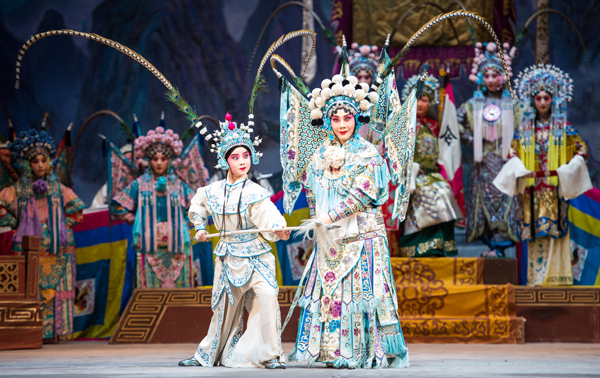
Women Generals of the Yang Family, a classical piece from the Peking opera repertoire, is coming to New York. [Provided to China Daily] |
The "Mei dynasty" of Peking Opera has come to an end. The heir to China's best-known opera clan, Mei Baojiu, died in hospital on Monday morning. The 82-year-old Mei was the youngest son of Mei Lanfang, China's legendary opera artist. Both father and son played Dan, or female roles.
As head of the Mei Lanfang Peking Opera Troupe, Mei Baojiu trained the next generations of artists and during his 70 years on stage, took 70 disciples. Mei Baojiu was married to Lin Liyuan, but the couple has no children. His older sister, Mei Baoyue, also a gifted opera artist, played mostly Sheng, or male roles. And she, too, didn't leave behind any children. This means no descendant of Mei Lanfang is still with Peking Opera today.
Peking Opera, or Jingju, as it is called in Putonghua, has become a powerful trademark. Jing means capital, ju a stage play. The Mei family had always insisted that it's jing, not yang-from xiyang-meaning Western. It's Chinese culture that makes it distinct.
The term Peking Opera suggests there are other regional operas in China: hundreds of them. And even within Peking Opera there are different pai, or schools. The Mei Pai (Mei School) of Peking Opera, for example, is considered zhongyong, or moderate.
For Westerners, watching Chinese Opera can be sense-overwhelming at first: (Percussion instruments) Dang, dang, dang, dang, dang, dang ... Ding! Pause ... flamboyant costumes, a drunken concubine; Dan, powdered like a cake, starts the most exaggerated piercing speech-singsong you will ever hear! (More percussion and wooden clappers) Ching, ching, ching, ching ... Clack, clack ... clack! Everyone gazes at the public display to read what she's been saying. A male enters: 6-inch-high-heels, enormous facial expression, effortless walk, gestures rehearsed a million times.
In Chinese performing arts there's a saying: "Taishang yifenzhong, taixia shiniangong." It means that we only see this minute of 10 years of practice. Just because actors have to start young in opera, it does not mean opera is for the young. The Stiftung Oper in Berlin reports that the average opera-goer in Germany is 51 years old. The Metropolitan Opera in New York reports that its average visitor is 57 of age.
Mei Baojiu's father, whose parents and even grandparents were actors, too, rose to almost super-human fame in the 1930s and 1940s, in no small parts due to the foreign press, to the point when Mei Lanfang became synonymous with Peking Opera. However, only his youngest son from his second marriage, Mei Baojiu, followed into his father's footsteps, at the age of 10. The Mei family saga is more fascinating, perhaps, than the fictional Buddenbrooks (by Thomas Mann): add the cross-dressing male divas and the spectacular kitsch and klimbimof reenacting Ming and Qing dynasties' eccentricities.
Mei Baojiu, during his final 10 years, realized two things: First, the grand plays and the history of Peking Opera must be part of the national curriculum (done, since 2008). And second, Peking Opera must be brought, if subsidized (as opera is in Germany, say), to international audiences. It was named "Intangible Cultural Heritage" by the United Nations in 2010.
Indeed, at no time in its history has Peking Opera enjoyed more prestige: Performances are organized from New York to Tokyo, from Munich to Edinburgh. In fact, Chinese Opera is technically the biggest in the world: Germany has 80 opera ensembles, China 1,000.
If only the world spoke a little bit more Chinese.
The writer is a cultural critic and the author of the forthcoming book Knowledge is a Polyglo



I’ve lived in China for quite a considerable time including my graduate school years, travelled and worked in a few cities and still choose my destination taking into consideration the density of smog or PM2.5 particulate matter in the region.
Copyright 1995 - . All rights reserved. The content (including but not limited to text, photo, multimedia information, etc) published in this site belongs to China Daily Information Co (CDIC). Without written authorization from CDIC, such content shall not be republished or used in any form. Note: Browsers with 1024*768 or higher resolution are suggested for this site.
License for publishing multimedia online 0108263 Registration Number: 130349