 |
|
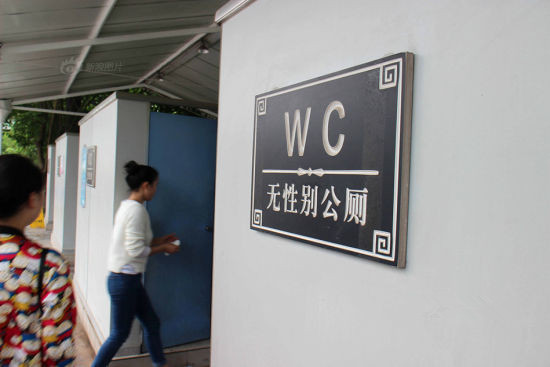
A woman walks into a unisex public restroom in Chongqing on April 15, 2015.[Photo/CFP] |
Chinese tourism authorities are promoting a "toilet revolution", which was long overdue. In fact, not only toilets at scenic spots, but also public toilets in other places need a "revolution".
Foreigners usually complain about the stench and foulness of toilets in busy public places such as train and bus stations. They also grumble about the lack of privacy in some public toilets, particularly in small towns in China's inland and rural areas. Most of the toilets in these places have no partition, not to speak of doors, denying any privacy to users. Fully-enclosed toilets are a rarity in these areas.
Older Chinese people, those from rural areas in particular, are used to the lack of privacy in public toilets-it's not rare to see men smoking or even chatting with one another while going about their business in open squat toilets-but foreigners find the experience embarrassing.
The embarrassment is intensified because foreigners-mostly Westerners-feel awkward and difficult when it comes to squatting. Imagine the distress of having to maintain precarious balance in a squat toilet, and at the same time being overwhelmed by the feeling of people observing you.
For these reasons, revamping of public toilets in China requires careful deliberation. For it is not just a question of cleanliness, privacy and better management, and not all public toilets in China are equal-many public toilets in cities are indeed spotless and do have all the trappings of a modern toilet. But there are clean and unclean toilets in the same city, sometimes even in the same neighborhood-such a difference is expectable in a fast-developing country like China.
The same difference is present in Chinese society too-the social contradiction of rapid infrastructure and social development. The urbane, better-educated Chinese are themselves aghast at the unhygienic and uncivil antics of some of their fellow citizens. In this sense, when the authorities talk of a "toilet revolution", they ought to treat the issue holistically. For one, they have to improve the standards of public toilets to match at least the expectations of the more socially advanced Chinese, who share the same sensibilities of cleanliness and privacy as Westerners. And that requires more than better management, including educational campaigns aimed at changing the habits of the less-hygienic people.
There is, however, a difference between Westerners and even urbane Chinese in the choice of toilet. Most Chinese people, despite having a commode toilet at home, would be unwilling to use one in a public restroom out of concern for hygiene or fear of contracting a disease. That's why the norm in China is still to have mostly squat toilets in public restrooms. I share the sensibility of the Chinese people after spending years in China, but I have the advantage of having become partly accustomed to squatting. The same cannot be said about foreigners who are only visiting China and whose squat is as clumsy and uncomfortable as their use of chopsticks. So, bearing all this in mind, the ongoing revamp should be aimed at equipping public restrooms with squat toilets as well as commode toilets in a ratio that's skewed toward the former.
The author is a freelance writer who specializes in culture, travel, and lifestyle.



I’ve lived in China for quite a considerable time including my graduate school years, travelled and worked in a few cities and still choose my destination taking into consideration the density of smog or PM2.5 particulate matter in the region.
Copyright 1995 - . All rights reserved. The content (including but not limited to text, photo, multimedia information, etc) published in this site belongs to China Daily Information Co (CDIC). Without written authorization from CDIC, such content shall not be republished or used in any form. Note: Browsers with 1024*768 or higher resolution are suggested for this site.
License for publishing multimedia online 0108263 Registration Number: 130349