 |
|
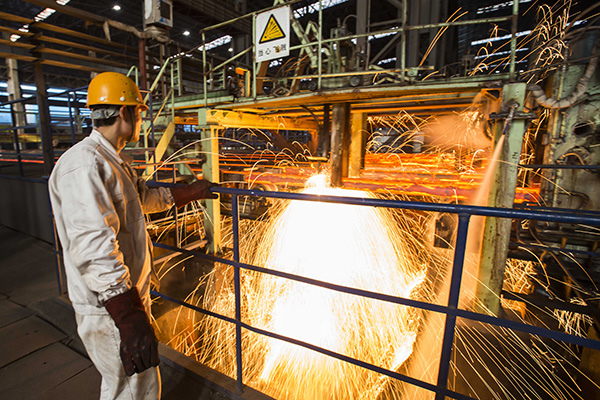
A worker at a steel company in Lianyungang, Jiangsu province, in January 2015. [Photo/China Daily] |
Blaming other countries is always an easy, surefire way for politicians to whip up a storm over domestic economic woes, but finger-pointing and protectionism are counter-productive to remedying those woes.
Last week, tens of thousands of German steel workers went on strike over steel products from China, while Indian steel giant Tata's decision to close mills in the United Kingdom saw a media flurry of accusations that China had flooded the market with products at artificially lowered prices.
It may seem reasonable at first to put the blame on China. But on closer inspection it is clearly just a lame and lazy excuse for protectionism.
Although China produces nearly half of the world's steel, the majority of its products are consumed domestically, and its exports to the UK and Germany account for only a small fraction of the two countries' imports, both in volume and sales.
Moreover, steel products from China are mostly of low added value, such as ordinary steel rods and plates, which many European countries no longer make and have to import anyway.
In fact, plenty of jobs have been created thanks to inexpensive Chinese steel products, as European companies buy these products and then use them to make goods they export.
It should be noted that overcapacity is a global challenge amid a sluggish world economy, and that China has been one of the countries hardest hit.
China has reduced its steel production capacity by 90 million tons over the past three years, and it plans to cut another 100 to 150 million tons of crude steel capacity over the next five years. And the massive layoff of workers is a great challenge.
The problem may be more marked for European countries due to union forces that keep their labor costs much higher than in many other countries. However, the last thing the world needs is a trade war over this issue. Far more jobs will be lost than gained if protectionism prevails.
The West's doubts and objections to China's market economy status might make it easier for them to accuse China of dumping products and justify the imposing of tariffs, but that won't solve the problem.
The way forward for global steelmakers is innovation and collaboration. High-end steel products are still in great demand despite the production glut, and cross-market cooperation can help allocate resources in an efficient and mutually beneficial manner.
It is time for the finger-pointing to stop, and instead, constructive reforms should be rolled out to improve competitiveness to ensure the sustainable growth of the steel sector.--Xinhua News Agency



I’ve lived in China for quite a considerable time including my graduate school years, travelled and worked in a few cities and still choose my destination taking into consideration the density of smog or PM2.5 particulate matter in the region.

Copyright 1995 - . All rights reserved. The content (including but not limited to text, photo, multimedia information, etc) published in this site belongs to China Daily Information Co (CDIC). Without written authorization from CDIC, such content shall not be republished or used in any form. Note: Browsers with 1024*768 or higher resolution are suggested for this site.
License for publishing multimedia online 0108263 Registration Number: 130349