 |
|
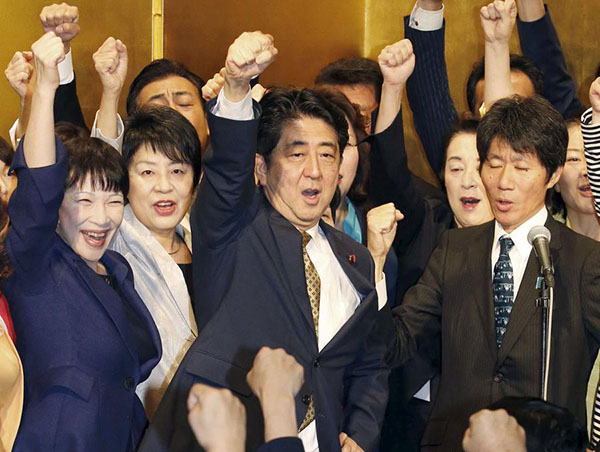
Japan's Prime Minister Shinzo Abe (C) raises his fist as he shouts slogans with his party lawmakers during a kickoff ceremony for the party chief election in Tokyo, in this photo taken by Kyodo, September 8, 2015. [Photo/Agencies] |
During the two-day G7 foreign ministers' meeting in Hiroshima, Japan, which began on Sunday, US Secretary of State John Kerry and the other G7 foreign ministers are scheduled to visit the Peace Memorial Park. Since the memorial is dedicated to the victims of the 1945 US atomic bombing of the city, Japanese media see the gesture as a call for nuclear disarmament and non-proliferation.
Japan is the only country to suffer a nuclear attack. The first atomic bomb was dropped on Hiroshima on Aug 6, 1945, and the second on Nagasaki three days later. The atomic bombs not only destroyed Japan's major military arsenals and killed Japanese troops stationed in the two cities, but also claimed the lives of about hundreds of thousands civilians. From a humanitarian point of view, Japan does deserve the world's sympathy.
The Japanese government symbolically chose Hiroshima as the venue for the G7 foreign ministers' meeting. And since Japan is the only victim of nuclear bombings, its call for nuclear disarmament and non-proliferation should not be opposed.
But China objected to Japan's proposal that global leaders attending the Nuclear Nonproliferation Treaty Review Conference at the UN Headquarters in April-May 2015 visit the two cities. In December, it was the UN General Assembly's turn to rebuff such a call.
So, why did China object to Japan's proposal? The Chinese people and government feel Japan is using the ploy of being a nuclear attack victim to make the world forget the horrors it inflicted on other countries.
Neither Japanese Prime Minister Shinzo Abe nor his predecessors have mentioned why the US dropped the atomic bombs on Hiroshima and Nagasaki. Instead, they have chosen to highlight the human sufferings the bombs caused. While trying to portray Japan as a victim, its leaders have never fully condemned the large-scale invasions of China and other Asian countries, and the atrocities such as the Nanjing Massacre the Japanese army committed. It is this evasive attitude of the Japanese government and media toward its war crimes that has prompted China and other Asian countries to object to Japan's attempt to disguise itself as the innocent victim of the nuclear attacks.
The countries that endured untold sufferings because of Japanese occupation or invasion will always call Japan's bluff. So Japanese leaders should face up to their country's war crimes and apologize to the wartime victims. They should also realize that, no matter what ploy they use they cannot change the historical fact that they unleashed a bloody war on Asian countries.
The Japanese government believes former US president Harry Truman committed an unforgivable crime by giving the order to drop the two bombs on Hiroshima and Nagasaki. But Truman's decision came after it was estimated that Allied forces would suffer another 1 million casualties before being able to conquer Japan's main territories. More importantly, the Japanese government rejected the Allied forces' call to surrender, leaving the US no choice but to drop the two atomic bombs to force Japan to surrender and end the war as soon as possible.
Given that it was almost impossible for the US forces to distinguish between Japanese troops and supporters of the war, on the one hand, and ordinary civilians, on the other, the unprecedented destruction the nuclear bombs caused should be blamed on Japanese wartime leaders' belligerent and adamant policies and actions.
It's the leaders that drag a country into war, but it's the people who always suffer the most. So people of all countries should learn how to differentiate justice from injustice, and stop their over-ambitious leaders from dragging them into unjust wars.
The author is a professor of Japan studies at China Foreign Affairs University.



I’ve lived in China for quite a considerable time including my graduate school years, travelled and worked in a few cities and still choose my destination taking into consideration the density of smog or PM2.5 particulate matter in the region.
Copyright 1995 - . All rights reserved. The content (including but not limited to text, photo, multimedia information, etc) published in this site belongs to China Daily Information Co (CDIC). Without written authorization from CDIC, such content shall not be republished or used in any form. Note: Browsers with 1024*768 or higher resolution are suggested for this site.
License for publishing multimedia online 0108263 Registration Number: 130349