 |
|
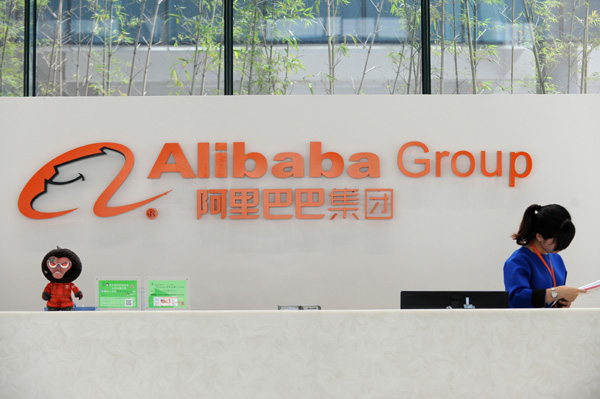
A receptionist works at Alibaba's headquarters in Hangzhou, capital of East China's Zhejiang province, in this Jan 30, 2015 file photo. [Photo/Xinhua] |
You may call it a move for fairer taxation.
You may call it a move to facilitate trade.
But you cannot sell it as a boon for Chinese consumers, because once the tax rules on online retail goods are changed on April 8, Chinese online shoppers will feel the impact and are likely to think twice about opening their purse strings.
Hence, Chinese policymakers, who are anxious to ensure tax revenues grow fast enough to help cushion the country's economic slowdown, should be cautioned that raising tax on consumers may prove a Pyrrhic victory.
The Ministry of Finance announced on March 24 that retail goods purchased online will no longer be classified as "parcels" and enjoy a "parcel tax" rate that is lower than that on other imported goods. Instead, online purchases from overseas will be charged the same as any other imported goods.
Currently, the country levies parcel tax on imported goods worth less than 1,000 yuan ($150), and the rate can be as low as 10 percent. Taxes under 50 yuan are generally waived. As a result, many online purchasing agents have sought to avoid paying higher taxes by repackaging and mailing products separately so they will only be charged the parcel tax, undercutting traditional retailers and importers who have to bear a heavier tax burden on their goods.
It is true that such a change will help level the playing field for e-commerce platforms and traditional retailers and importers.
It is also likely that the new policy will speed up customs clearance so consumers will receive most orders from overseas within two weeks, instead of two months.
Because of the jaw-dropping surge in import of retail goods bought online, it was reported that some Chinese custom officials faced an avalanche of parcels of small-sum imported retail goods especially during the online shopping holidays. .
By removing the tax advantage enjoyed by small-sum imported goods, the new tax rule should help accelerate the process of customs clearance by reining in the explosive growth in the number of small parcels they have to process.
Nevertheless, the new tax rate is indeed higher compared to what it used to be, the Ministry of Finance said.
Unfortunately, the assertion that it won't affect consumers too much is at best a goodwill guess that will need to be tested against consumer behavior after the change comes into effect.
Cross-border e-commerce has become such a rare bright spot of growth that the government has planned to set up more cross-border e-commerce pilot zones to attract businesses, create jobs and nurture new business models that will boost foreign trade and stimulate the economy.
The Ministry of Commerce predicted the volume of cross-border e-commerce in 2016 will reach 6.5 trillion yuan and will soon account for 20 percent of China's foreign trade.
The need to further expand online trade should be more than obvious as China just saw the total value of its exports and imports for 2015 decline 7 percent year-on-year, falling for the first time in six years.
The new tax rule will definitely help the government collect more tax revenues from consumers' online purchases of imported retail goods to marginally improve its fiscal position. But it is no answer to domestic consumers' rising demand for premium goods that Chinese manufacturers are yet unable to provide and which their supply-side reform should center on.
And if such a premature hike in tax does make a dent on Chinese consumers' enthusiasm to spend bigger and bigger on premium goods, it could prove costly for the country, which is aggressively pursuing consumption-led growth. Boosting consumption is never as easy as raising taxes.
The author is a senior writer with China Daily. zhuqiwen@chinadaily.com.cn



I’ve lived in China for quite a considerable time including my graduate school years, travelled and worked in a few cities and still choose my destination taking into consideration the density of smog or PM2.5 particulate matter in the region.
Copyright 1995 - . All rights reserved. The content (including but not limited to text, photo, multimedia information, etc) published in this site belongs to China Daily Information Co (CDIC). Without written authorization from CDIC, such content shall not be republished or used in any form. Note: Browsers with 1024*768 or higher resolution are suggested for this site.
License for publishing multimedia online 0108263 Registration Number: 130349