 |
| Cai Meng/China Daily |
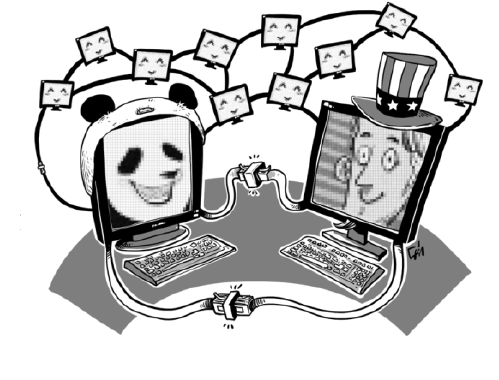
Chinese businessman Su Bin, according to some media reports, pleaded guilty to "cyber espionage" charges almost at the same time that China's Foreign Ministry announced President Xi Jinping's participation in the fourth Nuclear Security Summit in Washington on Thursday and Friday.
No wonder some media outlets and US officials are trying to cast a shadow over Beijing-Washington ties before Xi's meeting with US President Barack Obama on the sidelines of the nuclear summit. With vivid descriptions and seemingly "credible evidence", the reports have painted the picture of a plot in Su's case which resembles those in James Bond movies and some Hollywood blockbusters to catch eyeballs.
According to US Assistant Attorney General for National Security John Carlin, the admission of guilt by Su sends a strong signal that a heavy price has to be paid for stealing intelligence from the US and its enterprises, and Washington will-and has the capability to-capture those who do so and hold them accountable. An official from the Federal Bureau of Investigation's cyber section said the US should be on high alert against cyber threats because its adversaries are continuously raising their capabilities.
The reports also said that following Su's confession, the US is doubling its efforts to prevent "cyber espionage" by China.
That Washington chose to announce the "details" of Su's case on the very day that Beijing released the agenda for Xi's visit to the US suggests it is aimed at pressuring China into conceding some serious demands on cybersecurity. The making of "China's cyber espionage" story and its dissemination across the media and the international community are apparently aimed at spoiling China's reputation.
By doing so, the US can use the excuse of "judicial independence" to shirk its responsibility in such a case whenever China raises questions over Washington's cyberespionage activities.
The timing of the announcement is also a breach of basic international practice and diplomatic protocol, and exposes the US' hegemony mentality.
Despite appearing to be an accidental incident, the Su case shows the effects of the US' meticulous planning if seen in the context of the recent developments in Sino-US ties. Over the past year, the US' policy toward China has witnessed certain changes, making it increasingly likely that Washington would find faults with Beijing. This is not only related to the increasing anti-China rhetoric in the year of the US presidential election, but also to the growing "sense of anxiety" in the US' strategy toward China.
The intensifying strategic competition between the two sides because of China's steady rise has prompted some in the US to seek a strong response to China. It has also made them push for a "China-containment" policy by raising topics such as "cyber espionage" and "freedom of navigation" in the South China Sea to disturb the peaceful environment China needs for its development.
Considering that the expected meeting between Xi and Obama in Washington is likely to further advance Sino-US relations, Washington should reduce the media hype over the Su case and prevent it from disturbing the smooth development of bilateral ties, damaging mutual interests and endangering the US' strategic interests.
China and the US both should adhere to the agreements they reached at a high-level dialogue in December on fighting cyber crimes, for they are meant to guide them to seek common grounds, expand cooperation and avoid confrontation in the field of cybersecurity. More importantly, the US should discard its Cold War mentality and work with China to keep Sino-US ties on track in order to develop a new pattern of bilateral relations, which both have vowed to build.
The author is director of the center for crisis management studies, China Institutes of Contemporary International Relations.



I’ve lived in China for quite a considerable time including my graduate school years, travelled and worked in a few cities and still choose my destination taking into consideration the density of smog or PM2.5 particulate matter in the region.
Copyright 1995 - . All rights reserved. The content (including but not limited to text, photo, multimedia information, etc) published in this site belongs to China Daily Information Co (CDIC). Without written authorization from CDIC, such content shall not be republished or used in any form. Note: Browsers with 1024*768 or higher resolution are suggested for this site.
License for publishing multimedia online 0108263 Registration Number: 130349