 |
|
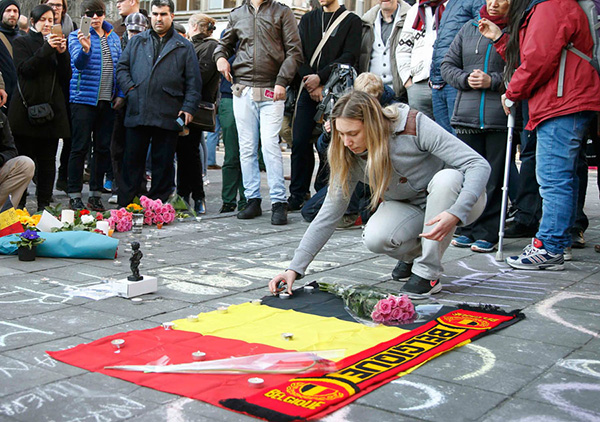
People gather around a memorial in Brussels following bomb attacks in Brussels, Belgium, March 22, 2016. [Photo/Agencies] |
A powerful blast ripped through a park crowded with families in Lahore, Pakistan, on Sunday evening killing at least 70 and injuring more than 300. Many of the victims were women and children. The suicide attacker targeted members of the Christian minority community when they were celebrating Easter Sunday.
On the same day a pipe bomb detonated about 5 miles from Disneyland in California, causing damage to the walls of a shuttered business establishment, according to local authorities. Police said no injuries had been reported.
Lahore's blast has something to do with the continuing sectarian clashes in Pakistan, where religious disputes, even serious confrontations, are often reported. The United States, too, is no stranger to sporadic attempts to threaten its public security.
The two incidents seem to be part of the increasing number of extremists-led attacks, especially in the West. Only a week ago, the terrorist attacks in Brussels killed 35 people and left more than 260 injured (some of them critically).
But saying that no country is safe from terrorism may be going too far, and could easily spread unnecessary panic and fear. On the surface, these attacks are connected with the notorious Islamic State or the Taliban, but terrorism has begun to take shape in Europe from within, not the other way round. In other words, the surge in extremist activities and attacks that have taken a toll on Europe may not be new to many regional players.
On the other hand, there is an inherent tendency in Europe that suggests homegrown jihadists have become a major security threat because they have little to do with European civilization. But the fact is, they are basically European citizens (although many are first-generation immigrants) who have become the "standard-bearers" of "Islamic extremism".
These Islamic extremists are familiar with local social rules, adept at using Internet tools and have access to various financing channels. For them, Islam is just a convenient means of spreading terrorism, not spiritual inspiration in any sense, because what they are trying to do is challenge the mainstream ideology and order.
Some Muslims have been known to jump into parochial and sectarian clashes, which normally are driven by regional and tribal sentiments, and hence are less likely to mount coordinated and organized attacks in the face of strong local security arrangements.
The IS group's brutality and efficiency is the result of its capability to recruit ignorant or fanatical youths by offering them financial support. As such, the IS group has nothing to do with any Islamic creed or sect. As the Syrian civil war de-escalates, thanks to the US and Russia agreeing to endorse a cessation in hostilities in the country, more terrorists might be forced to travel back to Europe to wreak more havoc.
Against the backdrop of waning Western control over global and regional governance, bloodthirsty extremists may find it easier to fill the void and expand their turfs in some small, fringe countries in the Middle East. It is these already weakened countries, not European nations or the US, which will face bigger security threats, because to a point, they are the victims of the so-called Islamic terrorism that has emerged in the West.
The author is an associate professor at the University of International Relations.



I’ve lived in China for quite a considerable time including my graduate school years, travelled and worked in a few cities and still choose my destination taking into consideration the density of smog or PM2.5 particulate matter in the region.
Copyright 1995 - . All rights reserved. The content (including but not limited to text, photo, multimedia information, etc) published in this site belongs to China Daily Information Co (CDIC). Without written authorization from CDIC, such content shall not be republished or used in any form. Note: Browsers with 1024*768 or higher resolution are suggested for this site.
License for publishing multimedia online 0108263 Registration Number: 130349