 |
|
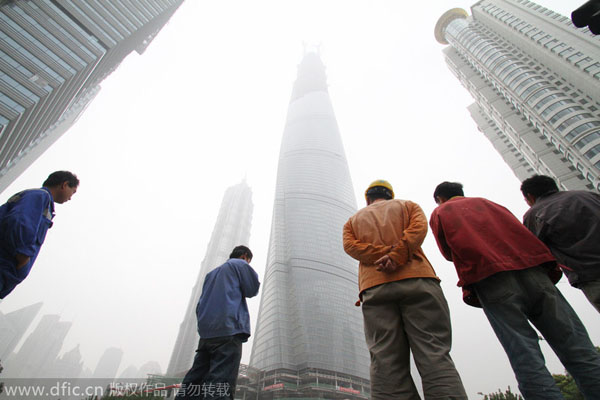
Migrant workers look up at skyscrapers in Shanghai on Nov 3, 2013. The disposable income of residents in China is on the increase. [Photo/IC] |
Rising inequality threatens to derail, from the start, successful implementation of the new 2030 Agenda for Sustainable Development in the Asia-Pacific region. Stronger, more equitable social protection will be critical in overcoming these challenges.
New research by the United Nations Economic and Social Commission for Asia and the Pacific (ESCAP) indicates that inequality, related to both outcomes and opportunities, is on the rise in the countries of Asia and the Pacific – and where it has not risen it has remained unacceptably high. This is having an adverse impact on sustainable development.
Growing disparities in income and wealth, as well as unequal opportunities, reinforce each other, creating an "inequality trap" that disproportionately affects women and the most vulnerable members of society, including the poor, youth, persons with disabilities, migrants and older persons.
This stands in sharp contrast to both the shared growth that defined the rise of the 'Asian Tigers' in the 1960s, and more recent trends in other parts of the developing world, in particular Latin America, where income inequality has been decreasing over the recent decades.
Over the past 20 years, the rich in Asia and the Pacific have grown richer, at the expense of the poor. Inequalities in regional opportunities also abound, with nearly 80 per cent of the population lacking access to affordable health care, and as many as 18 million children out of school. Access to these basic social services are considerably lower among low-income groups and rural communities.
In the context of the 2030 Agenda, inequality casts deep shadows on all three pillars of sustainability – economic, social and environmental.
Economically, inequality threatens regional dynamism, is destructive to the sustainability of growth, and makes it more difficult to reduce poverty through growth. Had Asia-Pacific inequality not increased, an additional almost 200 million people would have been lifted out of poverty in the three largest countries in the region over the last two decades.
Inequality undermines social cohesion and solidarity. A growing divide between the rich and the poor is often a factor in rising levels of crime and social unrest, undermining trust and weakening bonds of solidarity. In extreme cases, especially where inequality manifests along ethnic lines, it can lead to polarization, radicalization and even failure of the State.
Environmental sustainability is also hampered by inequalities, which create resentments and disincentives and, in turn, generate pervasive free-riding and overuse of resources, with unsustainable environmental outcomes. For instance, evidence from India and Nepal suggests that inequalities in local rural communities actually intensify deforestation.
This is why tackling inequality must be central to the sustainable development agenda. Perfect equality of wealth and income is not attainable but, when it comes to inequalities of opportunity, such as access to health and education, Asia-Pacific governments should not settle for less than a perfectly "level playing field."
It is encouraging to see that, in addition to traditional cash transfers, Asia-Pacific countries are introducing innovative measures to reduce inequalities, such as health equity funds, impact investing in education, universal health coverage and expanding access to old-age pensions.
Building on this momentum, countries could also develop sets of complementary policies to tackle inequality in all its forms:
First, national taxation systems could be strengthened. There is ample room to expanding the tax base and strengthen compliance frameworks across the region. This is an effective way of broadening fiscal space to finance redistributive mechanisms, while building solidarity across socioeconomic groups and generations.



I’ve lived in China for quite a considerable time including my graduate school years, travelled and worked in a few cities and still choose my destination taking into consideration the density of smog or PM2.5 particulate matter in the region.
Copyright 1995 - . All rights reserved. The content (including but not limited to text, photo, multimedia information, etc) published in this site belongs to China Daily Information Co (CDIC). Without written authorization from CDIC, such content shall not be republished or used in any form. Note: Browsers with 1024*768 or higher resolution are suggested for this site.
License for publishing multimedia online 0108263 Registration Number: 130349